ONE SOULFUL WARRIOR STANDING UP TO INDUSTRY WIDE RACISM

2020 saw most organizations in the eating disorder community dive head first into political correctness to see which could virtue signal the loudest. Some chose to include pronouns after their names believing that illustrates how enlightened and inclusive they are. (Quite frankly, that messaging seems a bit contrived and perhaps reflects more a sense of self-importance.)

Some organizations publicized how they were going to expand their membership and committee involvement to include greater representation among African Americans, Hispanics, LBGTQ and other minorities. (I can’t help but wonder why it took a tragedy to spur these organizations into this type of action and, even still, if this “action” ignores the fundamental issue.)

Some treatment centers, in order to show their “commitment to wokeness,” chose to display “Black Lives Matter” signs and postings about how “All Persons are Accepted Here.” (Again, I can’t help but wonder if those signs should have read, “All Persons Who Can Pay Our Daily Rate of $3500 are Accepted Here” ?)

Some therapists, specifically those who identify politically with the very far left, fell on the, “self-loathing, white guilt, white privilege, the world’s problems are all caused by white cis, straight, conservative men” sword while self-flagellating with pleas of mea culpa, mea maxima culpa. These therapists want to bring this self-loathing and apologies for our forefathers’ lack of sensitivity and vision into the counseling room and in a prime example of countertransference, are asking the few African American patients in that room to give them lessons in how to treat black persons as human beings. 

All words and promises. And yet, merely all words.

One year later where are we? Where is the white paper illustrating how pervasive racism is in the eating disorder industry, how and why it is perpetuated and what possible solutions must be explored? Where is the action? Now that over a year has elapsed, and US society is focused on the delta variant, the horrific scenes playing out in Afghanistan, a president whose fall into mental confusion appears to be escalating each day, trillions of dollars being proposed to be spent on anything and everything except for mental health, where is the hard, difficult action supporting those noble words and intentions expressed just one year ago?

How do we take action to support those noble words? What are the eating disorder organizations and foundations and treatment centers doing to insure that more black Americans receive the highest quality of care? Where is the action proposed by the ED Coalition on this issue? Where is the Residential Eating Disorder Consortium? Where is iaedp? Where is AED? Where is NEDA? Where are the treatment centers? Where are those individuals who stood up this past year and promised that things must change? Why is the silence on this issue so deafening? Who has any answers? For that matter, who even has a clue as to where the path begins to find possible answers?

As for that last question, perhaps the answer is found in the unlikeliest place, as it often is. In my journey the last 4 years, I have been so incredibly fortunate to have encountered people demonstrating the noble qualities of strength, inspiration, resolve and soulfulness in the least expected places. From a mother who sends me a message saying she believes I saved her child’s life. To young people who tell me that my daughter still inspires them. To sitting on the floor with young people in treatment and laughing with them, crying with them. To seeing the fear and exhaustion in a parent’s eyes and yet still seeing a fighting spirit. Seeing grace and strength when society and the eating disorder community has kicked our most vulnerable people when they have been down.

Often the path to enlightenment, the path which leads to answers lie in the unlikeliest of places. A few months ago, I was contacted by a patient who had just discharged from a treatment center. The story she told me seemed so fanciful that it could not possibly be true. And so, investigations began. Questions were asked. Sources were consulted. And the dominos began to fall. The Chief Clinical Officer resigned and is allegedly getting out of the eating disorder community. The Chief Operating Officer resigned. As questions continued to be asked, answers began to become in focus. And now, litigation is all but inevitable and looks to be filed in federal court in Los Angeles this week.

Litigation which has the potential to rock the eating disorder industry to its core. Litigation which will pull back the curtain of racism which has oppressed Black Americans and prevented them from receiving quality medical and mental health care. Litigation which will call into question the foundations of eating disorder organizations and treatment centers. Litigation which could lead to many, many more African Americans receiving life-saving treatment when the case reaches its inevitable and foregone conclusion.

Litigation which will happen because one person decided to stand up and be counted. One person who still suffers from her eating disorder. One person who found the courage within her to stand up and say, “Enough. No More. No More.”

This one person, this one incredible soul. This person is a forty-three (43) year old, single African American mother, who has two (2) children, who is classified as obese under the BMI, who has suffered from an eating disorder for over fifteen (15) years, who has a commission only paying job at which she excels when she is not in treatment, who is a lesbian. And the manner in which I just described this Soulful Warrior only describes her shell, her physical body, her corporeal existence, an existence which cannot possibly contain the incredible Heart of a Lioness and Soul of a Warrior which shines so brightly within her. This one incredible soul coming to me in an unlikely way and yet, who became a bright beacon and reminder of that which inspires me and keeps me on a path of helping the vulnerable.  

And maybe, just maybe, this one incredible soul will be the catalyst for action which brings life and meaning to the empty platitudes from last year.

One incredible soul.

It’s Not You, It’s Me

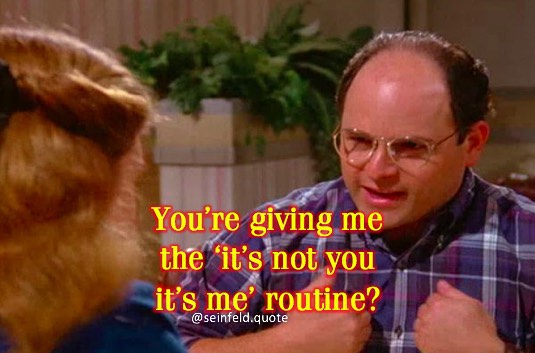
One particular Seinfeld episode shined a bright, comedic light on the phrase, “It’s not you, it’s me.” (Who among us have not used that line at least once, especially in our younger years, when we were “redefining the nature of our association” with our then girl/boyfriend?) It is classic. But, George Costanza elevated this term to a new height during this episode:

Gwen: I’m sorry, George.

George: I don’t understand. Things were going so great. What happened? Something must have happened.

Gwen: It’s not you, it’s me.

George: You’re giving me the “it’s not you, it’s me” routine? I invented “it’s not you, it’s me!” Nobody tells me it’s them, not me! If it’s anybody, it’s me.

Gwen: All right, George, it’s you.

George: You’re damn right it’s me.

Gwen: I was just trying to…

George: I know what you were trying to do. Nobody does it better than me.

Gwen: I’m sure you do it very well.

George: Yes, well, unfortunately you’ll never get the chance to find out.

[SCENE: Jerry’s apartment.]

Jerry: But I thought things were going great.

George: Yeah, so did I.

Jerry: Did she say why?

George: No. She tried to give me the “it’s not you, it’s me” routine.

Jerry: But that’s your routine.

George: Yeah. Well, apparently word’s out.

That episode and the phrase, “It’s not you, It’s me” recently came into my consciousness.

This year marks the 20th commemoration of 9/11. A date that changed this nation’s vision, if not our very soul. As we observe and remember that dark day years ago, we are also struggling with the global, mental health pandemic that has impacted so many of us.

And so, along with other mental health advocates and organizations, we are organizing a mental health resource fair to take place on Saturday, September 11, 2021.

Some of these organizations and philanthropists include Something for Kelly Foundation, Grant Halliburton Foundation, Mental Health America of Greater Dallas, Camp Wonderment, Center for Change, Mockingbird Pharma, Francisco Ayala, PhD and other mental health organizations, individuals and companies.

At this event, we will showcase a local band, yoga, singers and entertainers. The atmosphere will be light-hearted, joyous with a promise of hope for the future. Located in the heart of Addison, Texas, Prestonwood Pond, the site of the event, is a spring fed pond and is stocked with fish. The intent is to have an upbeat, fun “Morning in the Park” vibe. What there will not be is a “fun walk.” Fun walks long ago stopped being “fun.” A “Fun Walk” is an anachronism destined to take its place next to hula hoops, lawn jarts, beauty pageants and poodle dog skirts.

With in-person school in Texas having just started, we are reaching out to many schools and school districts, churches, temples and places of worship. With many Fortune 500 companies which call North Texas home, we are reaching out to them as well.  Our incredible volunteers are motivated, experienced and involved with the mental health field and are doing incredible work.

Over 30 exhibitors with mental health, medical and holistic specialties including most aspects of health in general have committed to appear and be the face of people dedicated to helping others. Our financial sponsors have been generous.

The VIP event the evening before has musical entertainment, special guests, laughter and incredible food. Indeed, this event promises to become an event that families will be able to embrace every year.

And yet, there have been some medical and mental health providers, respected professionals, professionals who are rightly admired, who when approached about this event, when asked to send representatives to this event, have responded with a statement along the lines of, “We are at the breaking point. We already have too much work, too many people reaching out for help. Our waiting lists are long. Our professionals are working themselves to the bone and are exhausted.” How can we possibly take on more? Their position is completely understandable. In order to provide the highest quality of care, our medical and mental health providers must take care of themselves. That is crucially important.

And yet, in response to those dedicated, hard-working professionals, [and that was said with sincerity, respect, and admiration for all they do … my God, they save lives. Is there a higher calling?] … imagine, if you will, a family of limited financial means, a BIPOC family perhaps, a family who is struggling. Their life, already so difficult before Covid-19 hit. And then, the fear, the isolation, the anguish, the pain, their very mortality strangles them in an icy grip of life or death as Covid-19 spreads globally. The parents, one or both of them, perhaps losing their jobs. Revered retail outlets permanently closing their doors. Unemployment nationwide sky rocketing.

Their children, not knowing if they will be at school in person, or virtual, are masks required or not, are we safe or not … trying to not only learn the lesson plan for the day but to try to make sense of this pandemic that even their parents cannot figure out. Imagine the fear. Imagine their need for help. Imagine … them living in such darkness searching for that one source of light. Desperately needing … hope.

Embrace that vision. And then those poor, anguished souls hear … I would like to help, but I am just too busy.

Look that heartbroken mother in the eyes. Look that depressed, forlorn father in the eyes. Look that innocent, fearful child in the eyes and then, listen to their words, as they look you in the eyes and you hear them whisper, “It’s not you, it’s me.”

We are facing such incredibly trying times. Times that test the very essence of who we are. There truly is a tsunami of mental health issues, of people lost, who believe they have been forgotten. Those people who need a hug, a smile, to share a tear with someone, who need soft tender words, who need to hear they have not been forgotten. Who need to hear they are important. Who need to hear they matter.  Who need to hear even if you cannot immediately help them, you know people who perhaps can.

It is not you, it is them.

That is what On Mindful Pond is about. It is not about making money. It is not about egos. It is not about our self-importance. It is not about going to San Antonio and hob knobbing with fellow addiction professionals knowing that while you are there you are not directly helping those who need you the most.

It IS about kneeling down and hugging a child. It is about looking a parent in the eyes and telling them they are not alone. It IS about sending a message that we are all God’s children, and we are there for those who most need our help. It is about looking past our exhaustion, and fatigue, and waiting lists. It is about giving a hug, looking a fellow human in the eyes and telling them, “You are loved. I am here for you, right here, right now. We are one.”

It is about telling those who need us the most, “It is about you, not me.”

That is the essence of On Mindful Pond.

That is the essence of our heart and soul.

That is why and how our life path directs us to help others.

That, is who we are.

A Day to Laugh, to Inspire, to Hope

So, today is the 28th birthday of my beloved daughter, Morgan.

And without this article, very few people may remember. Certainly her mother, Martha and her significant other. Me. My significant other. (I really don’t like that term. We must think of another one more succinct and fitting). Her brother, my incredible son, Hanford and his wife. We remember. And then …

Without a reminder, there may be very few.

And now for the difficult part… the realization that that is how life is meant to be. And yet, for a parent, when a child dies, their birthdays and their transition days are dates that are seared into our hearts. For us parents, our child going before us will always be a personal tragedy. We never get over it.

But, there is another reality that is also very real. As parents of children who transition before us, we must find a way to acknowledge that harsh reality. Life and death are absolute realities of our existence. The world moves on. Society moves on. Glorious life moves on. As parents who are living through the gut wrenching tragedy that our child was taken before us, that is the harsh reality we must face. And face it we do in different ways in accordance with our own individual strengths and weaknesses.

And for this one man, this one daddy, I would not want it any other way. For it surely must be, will be, and has been that way since time immemorial. (Or until that mad genius who lives down the street succeeds in devising AI capable of performing all job tasks and work for humankind allowing us a life of leisure. [Or to be eradicated by the Frankenstein of our minds]) The talks we have had and will continue to have on sentient beings, ethics, the soul and Skynet becoming self-aware have been epic. But, I digress.

Morgan being taken scarred me on a deep level. And yet, it also filled me with incredible drive and inspiration, substance and strength, hope and resolve. I have had to endure the greatest fear a parent could possibly face. And yet here I stand, “Stoikiy Muzhik.”  Through tragedy, my soul connected with me … and its path was revealed. In realizing that, instead of being mastered by that pain and anguish, I certainly must acknowledge the presence of that pain, but I also must acknowledge to a much greater degree hope for others, and inspiration that Morgan brought and brings to others.

Like so many parents who have had their child taken, I wanted her death to not be meaningless. I wanted an industry to stand up and take notice. By God, I would have people rise up and understand and embrace her legacy in a grand and mighty way and then go out and do great and mighty deeds! In Morgan’s name, we were going to save so many others. She would be remembered.

But, that is not the way of things. That is not the true path to salvation and remembrance. Great and mighty deeds? No. Instead, it is the small things. Salvation and soulfulness are found in the small things. The very small things.

We remember Morgan’s friend who gave her first child, her daughter, Morgan’s name as her middle name. Her friends, her sisters in treatment whom she inspired and helped, today may briefly remember her smile. Or the way she laughed. The way she pushed them to rise up and conquer. It will be those precious few who shake their heads remembering when Morgan did or said something incredibly … “out there,” or let’s face it, stupid. It will be those few who remember how good they felt when they were in Morgan’s presence. And yes, it will be those who swore they would not succumb as Morgan did. They will remember that it took Morgan falling so they could lift their own life. It is within those gentle souls who find the strength within themselves to heal that we find our successes, our joys, our true love in life.

And so, for those who remember, or who choose to remember, I ask them to do what I choose to do today, what I surely must do not just today but every day … remember her laughter, her smile, her love, how she inspired and yes… it’s ok to recall her many flaws and weaknesses. Like her father, she did have flaws and weaknesses. Sometimes in abundance!

For parents who have children, call them today. Talk to them, tell them you love them. Laugh about a great, shared memory. And allow yourself to feel love and hope for a much greater future that is surely before you.

Today, on Morgan’s birthday, I choose to laugh, to live, to love, to embrace a better tomorrow. For in doing so, if I can give even one person hope, a chance at a better tomorrow, as Morgan most surely did and would want me to do, is there any better birthday gift to give to your child? And yet, whatever birthday gift I ever gave to her in the past and give to her today, pales in comparison to what she gave to me. You see … she gave me the recognition of and connection with my very soul. Being inspired by my beloved daughter to seek out that seedling of hope and love in a forest of tears and pain.

So, for those who loved Morgan, yes, it’s ok to feel a bit of pain. But then, rejoice in the laughter she brought to you. The joy. The life. The love. Hold your head higher. Raise your glass. Remember and celebrate a life that yes, was cut far too short, but so well lived. Remember and smile.

As I surely will.

ON THE SHOULDERS OF GIANTS

If I’m making an impact, I’m not aware of it. People who make impacts don’t know. They are not thinking about, ‘Oh, how will I look from this angle.’

         Ruth Sharp Altshuler

Some people are just naturally “larger than life.” They instinctually rise above the fray with courage, strength and dignity. They look upon obstacles as opportunities. And when we are touched by them, when their paths cross ours, we instantly know that our lives are so much richer.

So were the lives of Ruth Sharp Altshuler and her husband Dr. Kenneth Altshuler. To go into all of their achievements, to detail the lives they saved, to articulate the many ways in which they left the world a better place would take far too many words and would involve reams of paper. So, I can only summarize the many ways in which they improved society.

Ruth Altshuler was born on March 10, 1924, and raised in a home on Swiss Avenue.  At an early age, Ruth found her calling to help those less fortunate that herself. During one interview, Ruth credited her acts of compassion to one simple thing: “Guilt!” She stated, “When I joined the Junior League, I realized how privileged I had been my whole life. It was fortunate because it made [volunteering] a career for me.” And so, she became one of the most tireless and influential volunteers and civic leaders Dallas has ever seen. Through her decades of philanthropic work, she raised millions for area charities.

In addition to raising millions of dollars, Ruth also donated millions of her own. She served as chairs of both the Carr P. Collins Foundation and the Sharp Foundation. She helped SMU’s students by creating the innovative Altshuler Learning Enhancement Center and helped recognize the university’s outstanding faculty by establishing the Altshuler Distinguished Teaching Professor Award. 

For nearly 50 years she served as an SMU trustee and was the university’s first female board chair. In fact, Ruth’s lifetime of service was filled with many firsts. She was the first woman to serve on a grand jury in Dallas, the one that indicted Jack Ruby for killing Lee Harvey Oswald. She was the first woman on the board of First Republic Bank of Dallas. She was the first woman elected Chairman of the Executive Board of Highland Park United Methodist Church, and first female Chairman of the Board of the United Way of Metropolitan Dallas. She was the first lifetime member elected to the National Salvation Army Advisory Board, and was a founding board member of the Susan G. Komen Breast Cancer Foundation. She was also the first woman to serve as a board member of the Salvation Army of Dallas, Goodwill Industries, and the Dallas Citizens Council. 

President George W. Bush appointed Ruth to the Library of Congress Trust and she served on the board of the Laura Bush Foundation for America’s Libraries.

In 2004, Secretary of State Colin Powell named her to the United States Commission to the United Nations Educational, Scientific and Cultural Organization (UNESCO). In 2011, she became the first person in the U.S. to receive all three national service honors: the Outstanding Philanthropist of the Year Award from the National Society of Fundraising Executives; the national Alexis de Tocqueville Award of the United Way of America, and; the Distinguished Service Award given by the Association of Governing Boards of Universities and Colleges. She was one of three life members of the Salvation Army’s National Advisory Board. 

Ruth was undeniably a tireless and selfless champion for those suffering from mental health issues. And, she will forever be memorialized through her induction into the State of Texas Women’s Hall of Fame.

Toward the end of her life she ended every speech with her favorite quote by Albert Schweitzer, “Example is not the main thing in influencing others. It is the only thing.”  She left us on December 8, 2017 at 93 years old. And her passing left a void that cannot be filled.

So too, her beloved husband, Dr. Kenneth Altshuler also impacted countless lives and saved many more.

Over the course of a twenty-two year career at Columbia University, he became a pioneer in studying mentally ill patients with profound early deafness, and creating services for them. His work was made part of the State services for the mentally ill in New York, and was duplicated in several countries overseas. His awards for his work at Columbia University are too numerous to list.

He left Columbia University in 1977 to become the Chairman of the Department of Psychiatry at UT Southwestern Medical Center in Dallas. Charged with building an outstanding Psychiatry Department from one that was virtually defunct, he recruited outstanding faculty, raised fifty-two million dollars in departmental endowments, and increased the full-time faculty from five to over one hundred.

He received the Texas Star Award from the Texas Mental Health Association, the Outstanding Psychiatric Award from the North Texas Society of Psychiatric Physicians, and he was a two-time recipient of the Prism Award for community service from the Dallas Mental Health Association. On the national scene, Dr. Altshuler served as a Director of the National Board of Medical Examiners, as President of the National Association of Chairmen of Departments of Psychiatry, and as a Board Member and then President of the American Board of Psychiatry and Neurology.

In 1999, Governor George W. Bush appointed him to the Board of the Texas Department of Mental Health and Mental Retardation (1999-2004). Dr. Altshuler left us at age 91 on January 6, 2021. According to those who knew him best, Dr. Altshuler was always a source of clear thinking and deep wisdom, a person to be counted on for kindness and intelligent support.

To recognize the tremendous impact Ruth Altshuler had upon the mental health community in North Texas, Mental Health America of Greater Dallas started the “Ruth Sharp Altshuler Prism Award for Community Service.” This award is given annually to persons or organizations who have made a significant contribution to improving the mental health of the Dallas community. Past recipients have tenaciously fought for years and sometimes decades to improve the mental health of the Dallas County community.

Approximately two weeks ago, I received a call from the Mental Health America of Greater Dallas. During this call, I was told I was to be the recipient of the 2021 Mental Health America of Greater Dallas Ruth Sharp Altshuler Prism Award.

I was not even aware that I had been nominated. And then, after conducting research into the rich lives of Ruth Sharp Altshuler and Dr. Kenneth Altshuler, and after discovering some of the past recipients, I seriously wondered if a mistake had been made. These people were giants. I became involved with the mental health community only after my beloved daughter, Morgan was taken on October 30, 2016. But for that personal tragedy, there is a substantial likelihood that I would not be actively involved in the mental health community. I also believe that whatever meager accomplishments I have managed pale in comparison to past award winners.

And yet perhaps the obstacles, opportunities, twists and turns presented on our soul’s journey are not meant to be fully understood. Perhaps we are only meant to persevere, to keep our egos and selfish wants and perceived needs on the sidelines and continue going forward.

As surely we must.

SB 184 and World Eating Disorders Day

Today, June 2, 2021 is World Eating Disorders Day. For the most part, mainstream society does not know it exists. But, for those who have been devastated by eating disorders, it is one more significant day, a reminder of that which was taken from us. One more noted day in which we remember. A day to remember how parents like me, frighten so many of those involved in the eating disorder community.

But for today, we choose to not mourn the fallen but to embrace the future. For it is only by embracing a future with hope, with compassion, with strength and with resolve, that we can hope to save the lives of others. And so, let us embrace hope by first looking back at the recent past. At an event which occurred that gives us hope for the future.

Thursday, May 20, 2021.  A date the eating disorder community should celebrate. For on that day, an eating disorder bill was approved by a House of Representatives and a State Senate and sent to that state’s governor for signature. And it happened in one of the most unlikely of places. On that date, Senate Bill 184 (SB 184) was sent to Governor Greg Abbott for signature. What was that state? Texas.

What is SB 184?

SB 184 is embedded here:

https://legiscan.com/TX/text/SB184/2021

First, SB 184 was overwhelming approved with support from both Republicans and Democrats in the Texas State House and Senate.

So, why is SB 184 important?

It is axiomatic that when you build anything, a house, an office building, a relationship, an organization, you MUST first build a strong foundation. Without a strong foundation, you are building a mirage, a castle on sand. SB 184 builds a strong foundation. This bill states in material part:

(a)       The Department of State Health Services, in collaboration with the Health and Human Services Commission, shall prepare a report on the prevalence of eating disorders and eating disorder-related deaths in this state. The report must include:

(1)       A regional and statewide statistics regarding the prevalence of eating disorders and eating disorder-related deaths in this state;

(2)       An overview of national trends in eating disorders; and

(3)       An overview of state-funded behavioral health treatment options available to persons with eating disorders.

From that Report,  no later than December 1, 2023, the Department of State Health Services and the Health and Human Services Commission is required to prepare and submit to the legislature a copy of the report and any recommendations for legislative or other action to reduce the prevalence of eating disorders and eating disorder-related deaths in this state.

That’s it.

There is no demand for state funding. No education requirement. No nutritional teaching mandate. No demand for social engineering. Instead, the message of SB 184 is fundamental and clear, that is, we must first thoroughly understand this disease, how prevalent it is, how deadly it is and what current options exist to treat it. For it is only by thoroughly understanding the problem that we can hope to find real life solutions.

Further, this process of analyzing problems has a history of success in the State of Texas. A past legislature mandated a comprehensive white paper on overall mental health services for children in the State of Texas. In December of 2018, a 145 page paper was distributed to all of the incoming Representatives and Senators in Texas. This white paper resulted in SB 11 which created the Texas Child Mental Health Care Consortium which organized a collaborative entity among the health related institutions of higher learning, state agencies and private organizations to study and then find solutions for increasing access to mental health care on a state-wide basis.

On this World Eating Disorders Day, at least in Texas, we choose to not look at mistakes of the past. We choose to not question past decisions or eating disorder organizations or entities. Instead, we choose to embrace hope. We embrace vision. We embrace wisdom. We embrace the opportunity to strive forward, to look toward a brighter future. In Texas, a foundation is being built. A foundation that will support a mighty house upon which we can save lives, one precious life at a time.

NO, WEIGHT STIGMA AND DISCRIMINATION ARE DIFFERENT

Contrary to the belief of a certain eating disorder organization:

Weight stigma and weight discrimination are not the same and in fact, are different in many important ways. There is no “chicken or the egg” argument with regard to weight stigma versus weight discrimination.

Some of the material differences are best illustrated in the following, simple definitions:

Weight stigma involves negative attitudes toward people who are obese. Weight stigma is social devaluation and denigration of people perceived to carry excess weight. This type of stigma is more often than not, a precursor to weight discrimination but does not rise to the level of negative conduct and is not actionable in court. And  yet, it is serious.

Weight discrimination is defined as unequal treatment resulting from stereotypes, rejection or prejudice towards people because they are obese. The unequal treatment is associated purely with a person’s weight. Discrimination is manifested conducted directed toward a person or group of persons.

The judicial system in the United States only considers weight discrimination. Cases filed under the Americans with Disabilities Act (“ADA”) address conduct constituting possible weight discrimination. Despite research demonstrating that negative attitudes are having an impact on how obese people are treated in the workplace, weight discrimination in the workplace is still legal in forty-nine states.

Essentially, this means that due to the long-recognized practice of at-will employment and termination of employment, anyone who is classified as obese may be fired due to weight discrimination in the workplace. This sets a dangerous precedent, one in which employers can body shame their employees. Furthermore, based on the fact that women report more incidents of weight discrimination in the workplace, it reinforces the cultural ideation that women are valued more on how they look, than they are for their skill set.

Why is weight discrimination not illegal?

So, how does our judicial system look upon weight discrimination in the workplace? The laws governing weight discrimination are based on constitutional prohibitions, and on state and federal statutes.

The U.S. Supreme Court has established certain tests for determining whether disparate (different) treatment of a group is discriminatory and illegal. If the treatment is based on what the law refers to as a “suspect classification,” the disparate treatment will be subject to “strict scrutiny.” A suspect classification is some characteristic of the victim, typically immutable (one that cannot be changed, such as age, gender or race), that has no bearing on the person’s ability to perform his or her job. Under current Supreme Court rulings, there are four traits that are considered suspect classifications: race, national origin, religion and alienage (the status of being an alien).

Courts have also identified what are known as “quasi-suspect classifications,” including gender and legitimacy of birth. Actions based on either of these characteristics are subject to “intermediate scrutiny.”

If the basis for the disparate treatment is neither suspect nor quasi-suspect, the court will only concern itself with whether or not there is a “rational basis” to treat the group differently. Disparate treatment based on disability, political affiliation, age, wealth or status as a felon—all are subject to the rational basis test.

Since obesity is not a suspect or quasi-suspect classification, courts will only consider whether there is a rational basis for an employer to treat obese persons differently. But first, the fundamental question, “Is Obesity a Disability?” must be asked. If the answer is always no, the analysis ends at that point. And that is where the Militant Fat Activists (“MFA”) hurt the very cause they are advocating.

Is obesity a disability? If it is not, then for the most part, employers can discriminate based on weight no matter how vociferously the MFAs argue, protest, harass and harangue. If a litigant cannot show that obesity is a “protected class” under the ADA, they will lose.

The ADA protects employees and applicants with disabilities from discrimination, and requires employers to make reasonable accommodations for employees with disabilities. The ADA states that height and weight, within normal parameters, are not disabilities. However, some courts and the Equal Employment Opportunity Commission (EEOC) have found that obesity may qualify as a disability, at least in limited circumstances:

  • If an employee or applicant has an underlying physiological impairment that has resulted in obesity (such as diabetes), the employee may be protected. The employee would have to prove that he or she had a disability as defined by the ADA. In other words, the employee would have to show not only that he or she had such an impairment, but also that it substantially limited a major life activity or major bodily function.
  • The EEOC has said that “severe” obesity, defined as weight that is greater than twice the average weight, is itself an impairment that could be a disability. Again, the employee would have to show that it substantially limited a major life activity or major bodily function.

But, according to the MFAs, obesity is never a disability. They believe that if you even use the biomedical word “obesity” you are “fat-phobic.” You can have health at your size! Medical community be damned … ignore your science, research and facts and listen to our anecdotal stories! If obesity is not ever a disability, then the MFAs who espouse that position are undermining themselves, obesity can never be the basis for a violation of the ADA and companies will be permitted to continue to discriminate at will based on obesity.

Corporations and Weight Discrimination

However, a corporation has no emotional incentive to engage in weight discrimination. From a public relations perspective alone, if a corporation was found to be engaging in overt acts of weight discrimination, the financial and societal ramifications could be devastating. In these times of “The Great Race to the Top of Woke Mountain,” many corporations seem to be vying to be the king of that mountain. “Mirror, mirror on the wall, who is the wokeist one of all?”

So, what incentive does a corporation have to combat weight stigma in the workplace to lessen the likelihood of weight discrimination? We can perhaps find the answer to this question in the February 2020 edition of the Journal of Occupational and Environmental Medicine.

In that Journal, an extensive multi-year study on the economic costs of obesity was published. Its findings showed that when compared with a lower BMI, obesity was associated with higher direct healthcare costs and indirect work loss-related costs, including costs related to disability, absenteeism (absence from work, such as sick leave), and presenteeism (reduction in productivity while at work). This report cited The Milken Institute report. The Milken report estimated a total cost of $1.72 trillion associated with obesity and its related comorbidities in 2016. 

Of this $1.72 trillion, $480.7 billion was incurred in direct health-care costs and $1.24 trillion in lost productivity. This study drew on research evidencing how being obese (as that term is defined by the biomedical community) elevates the risk of diseases such as breast cancer, heart disease, and osteoarthritis, and estimates the cost of medical treatment and lost productivity for each disease.

To combat this loss of revenue, numerous studies indicate that corporations which have an aggressive employee wellness program tend to be more employee friendly places to work. These corporate wellness programs result in improved employee health behaviors, reduced elevated health risks, reduced health care costs, improved productivity, reduced absenteeism, and improves employee recruitment and retention.

Corporations attempt to address obesity issues and weight stigma through extensive employee wellness programs. Corporations, people and organizations have financial incentives to encourage wellness programs. Weight discrimination lawsuits are not likely to succeed. Further, the MFAs continue to sabotage the ability to succeed in courts. So, we are justified in questioning why the MFAs continue to fight losing battles in the eating disorder community when an established fat acceptance community exists and would be far more welcoming.

The National Association to Advance Fat Acceptance (“NAAFA”) was founded in 1969.  It is a non-profit, all volunteer, fat-rights organization. It is dedicated to protecting the rights and improving the quality of life for fat people. The NAAFA seeks to eliminate discrimination based on body size through advocacy, public education and support. MFAs and the NAAFA would seem to be a match made in … well somewhere.

The MFAs may argue that weight stigma and weight discrimination are as important as any other issue because they dramatically impact eating disorders. They argue a Zero Sum Game and detract and distract from all other issues which plague persons afflicted with eating disorders. But, MFAs tend to be primarily “Fat Acceptance Advocate Wolves” first and foremost merely dressed in the sheep’s clothing worn by the eating disorder community.

This is especially true when we consider that not all people who are defined as obese have eating disorders.  With all of the fundamental dysfunctionalities inherent in the eating disorder community, why would any responsible eating disorder organization solicit donations ostensibly for eating disorder advocacy and research and yet then turn around and apply those donated funds to attempts to have weight discrimination laws implemented in various states?

In 2019, one now disgraced, former officer of an eating disorder organization disclosed, “[XXXX] is currently working with five other states in anti-weight discrimination legislation around the country, but there is still plenty of work to be done.”  Weight discrimination? Not eating disorders research or treatment?

And yet as shown above, since this same organization in 2019, demonstrated that it did not understand the significant differences between weight stigma and weight discrimination, it is not surprising that it would pursue its off mission agendas.

Weight stigma is a serious issue. Weight discrimination is a serious issue. Weight stigma can be a triggering element leading to an eating disorder. And yet …

No federal bills on research into eating disorders have been filed since 2013.

There are no generally accepted standards of care in the industry.

There is very little federal or state ethical oversight over therapists and counselors.

There are no agreed upon standards regulating marketing of services provided.

The mortality rate for eating disorders continues to escalate.

Covid-19 has resulted in increased eating disorder issues amongst all populations.

So called eating disorder community leaders refuse to support collaborative studies because of “personality differences.”

Intolerance and animosity have run a number of highly respected mental health care professionals out of the eating disorder community.

With these tremendous issues and problems plaguing the eating disorder realm, are weight stigma and weight discrimination the cross upon which we want to hang not just our future, but the future of our children? After all, NAAFA has 52 years experience in handling fat acceptance and weight discrimination. There is no doubt that the NAAFA would welcome Militant Fat Activists with arms akimbo.

It is long past time for fresh thinking, new ideas and rational, intelligent solutions to be presented. Just as it is long past time for bad actors, charlatans and frauds to be exposed and removed from the community.

Lives depend on it.

Militant Fat Activists – In Nomine Patris, et Filii, et Spiritus, Sancti

The only thing necessary for the triumph of evil is for good men to do nothing.

            Edmund Burke, Irish Statesman and Philosopher

What is objectionable, what is dangerous, about extremists is not that they are extreme, but that they are intolerant. The evil is not what they say about their cause, but what they say about their opponents.

            Robert Kennedy

“… once evil is invited in, tremendous effort is required to show it to the door and kick its cloven hoof off the threshold.”

            E.A. Bucchianeri, Author, Vocation of a Gadfly

For a number of years, Militant Fat Activists (“MFAs”) have been allowed to infiltrate and wreak havoc in the eating disorder community. This is particularly perplexing since obesity, in and of itself, is not recognized nor treated as a mental illness. Whereas, research studies seem to indicate that people at a higher weight are at increased risk of disordered eating compared with the general population, living in a larger body (or “obesity” as it is referred to in a biomedical context) is not an eating disorder or mental disorder. And yet, MFAs have engaged in reprehensible conduct without consequence or ramifications in the eating disorder community.

MFAs have verbally abused, interrupted and harassed medical and mental health experts giving presentations at national and international conferences.

MFAs have demanded that the medical and mental health professionals stop using the terms “obesity” and “overweight” because they are allegedly terms of derision which do not accurately describe a health condition. According to one MFA, “the medical community has it all wrong.”

MFAs have demanded that weight stigma and weight discrimination be elevated to the highest level of importance in the study and research of eating disorders.

MFAs have looked upon the research and treatment of eating disorders as a “Zero Sum Game” in which the eating disorder with the highest mortality rate, anorexia nervosa, must be minimized because anorexia is traditionally represented in the media by thin, white women.

MFAs have taken HAES, a principle that was designed by very few people and which has no research based origins, to address their own, one sided perspectives on social justice and healthcare. They moved it away from  their self-proclaimed, “new, peace movement.” Instead, MFAs have turned it into an angst filled, antagonistic, sordid battleground as they bask in their own self-loathing. If you disagree with any of their positions, you are “fat-phobic.”

MFAs uncompromisingly promote their own positions as superior to all others and thus betray their own core values of inclusion and equality whether you are on the privileged or disadvantaged spectrums.

MFAs refuse to intelligently discuss the obvious medical and societal shortcomings of HAES and instead attempt to denigrate and back stab any persons who do not slavishly adhere to every nuance of HAES no matter how extreme, illogical or ignorant of medical knowledge those positions are.

MFAs make blatant misrepresentations to the general public in order to solicit donations ostensibly for eating disorder advocacy when in truth and in fact, those persons are soliciting donations for “fat-centric” weight discrimination laws.

MFAs utilize and bastardize eating disorder organizations to further their own agendas, agendas which emphasize obesity and fat acceptance rather than eating disorder research.

There are many other ways in which MFAs have caused an incredible amount of harm in the eating disorder community. MFAs cause this harm without regret, without remorse and without apology. And yet ironically, MFAs cannot grasp that they are the very authors of their own destruction.

For with a more reasoned, intelligent, rational approach, “obesity” could have been elevated into a protected right under the Americans with Disabilities Act (“ADA”). As a practical matter, this means that employers could not discriminate against people who are fat, obese or “morbidly obese.” People who provide housing not only could not discriminate but would have to provide special accommodations. Through intelligence, guile, wisdom and collaboration, MFAs could have already reached one of their main goals. And yet even using the word “obesity” is tantamount to waving a red flag in front of a charging bull… a bull which is heedlessly running to its own demise.

So, let’s explore how the MFAs have self-sabotaged their own movement.

There is no Constitutional right to Health Care.

MFAs have argued there is a constitutional right to health care for fat persons or obesity. They are incorrect.

First, the U.S. Constitution does not set forth an explicit right to health care … unless you are incarcerated. The Supreme Court has not interpreted the Constitution as guaranteeing a right to health care services. While the U.S. Constitution and Supreme Court interpretations do not identify a constitutional right to health care for those who cannot afford it, Congress has enacted numerous statutes, such as Medicare, Medicaid, and the Children’s Health Insurance Program, which establish and define specific statutory rights of individuals to receive health care services from the government.

So, any type of argument alleging there is a Constitutional right to health care for obesity or fat people will fail in the United States court system.

Civil Rights laws do not apply to obesity.

Sadly, one now disgraced, former officer of an eating disorder organization stated, “It’s a civil rights issue because people are discriminated against and harmed by their body size.” To characterize that statement as foolishly wrong and misguided would be charitable.

Title VII of the Civil Rights Act of 1964 prohibits discrimination on the basis of race, color, religion, sex or national origin. Provisions of this civil rights act forbids discrimination on the basis of sex, as well as, race in hiring, promoting, and firing. The Act prohibits discrimination in public accommodations and federally funded programs.

But, Title VII does not include obesity as a protected standard. This means it does not prohibit employers from discriminating based on weight or obesity. In fact, there is no federal law protecting persons who are overweight or obese. Only 1 of the 50 states  has passed legislation protecting overweight or obese people in the workplace.

So without the protections of the Constitution or civil rights laws, the MFAs logically should be turning towards the Americans with Disability Act (“ADA”) for statutory protection and expansion of their mission. And yet, MFAs stubbornly refuse to pursue that option.

The Americans with Disabilities Act

The ADA protects employees with disabilities from discrimination, and requires employers to make reasonable accommodations for employees with disabilities. The ADA states that height and weight, within normal parameters, are not disabilities.

Under the ADA, “disability” is defined as “a physical or mental impairment that substantially limits one or more major life activities of such individual.” In 2008, Congress amended the ADA to provide a broader interpretation of the definition of disability, and added a “regarded as” disabled component of disability discrimination.  Thus, under the amendments, employees who cannot show they have an actual disability within the meaning of the ADA may nonetheless prevail if they can prove their employer regarded them as disabled.

The EEOC issued interpretive guidance explaining that the definition of the term “impairment” does not include physical characteristics, including weight, that are within “normal” range and are not the result of a physiological disorder.  Applying a “natural reading” of the EEOC’s interpretive guidance, four federal courts of appeal (the courts just below the US Supreme Court) have all held that obesity alone, without evidence of an underlying physiological condition, is not a physical impairment amounting to a disability under the ADA. In 2020, the Fifth Circuit in dicta, also made this determination.

Therefore, the law appears to be settling on the principle that obesity only qualifies as a disability under the ADA if it is caused by an underlying physiological disorder or condition (such as Type 2 diabetes, hypertension, or a thyroid disorder) and that obesity is an ADA impairment only if it is the result of an underlying physiological disorder or condition. In addition, the EEOC has said that “severe” obesity, defined as a weight that more than twice the norm, is itself an impairment that could be a disability. Again, the employee would have to show that it substantially limited a major life activity or major bodily function. So, why is this so important?

If the MFAs were willing to intelligently discuss the benefits and drawbacks of HAES and their views on obesity in an objective manner, working with the medical community to further a “severe obesity as a disability” agenda in the court system, that could have resulted in unprecedented progress in advancing their objectivities in the courts, before legislative bodies and in mainstream society. Yet, MFAs cannot get out of their own way.

Hoisted With Her Own Petard

Instead of engaging in a lucid, thoughtful strategic plan emphasizing positivity and long term goals and objectives, the MFAs blindfold themselves and attempt to play a game of checkers using bottlecaps for some of the missing pieces on Funk & Wagnall’s porch.

MFAs do not trust evidence base medical or mental health care for the reason that it allegedly did not help them. They openly state that there are people who are publicly chastised and harmed continuously by the medical profession. They believe that public health in this country is getting it so wrong and that there is a better way. And all people need to do is ignore science and medical professionals and be willing to actually listen to those being harmed.

MFAs seek to play the ultimate Zero Sum Game by stating, “We must also be centering and supporting BiPOC, LGBTQ+, fat therapists and professionals. This is no space for white, straight and thin folks to jump in.”

We even have examples of how MFAs have sabotaged their agenda in court. In the case of Gena Powell vs. Gentiva Health Services, Inc. filed in a federal court in Alabama, Powell worked for the defendant for about one year. Powell alleged that the defendant terminated her employment on the basis of her disability, “morbid obesity,” in violation of her rights under the ADA.  Powell was 5’3”, approximately 230 pounds.

With respect to her weight, Powell testified, “I know I’m overweight, I’m not an idiot.” And then, despite the fact that she sued on the basis that her disability was caused by morbid obesity, she claimed then not to be disabled, that her weight did not impact her job or her daily life activities. No medical expert testimony was offered to refute Powell’s statements. Naturally, the court made short work of Powell’s case.

One can only imagine how differently the case would have turned out had Powell been open to embracing the medical community to assist her claim and lack of self-awareness. A positive decision in the Powell case could have been a springboard for other cases and the precedential value of that decision would have been utilized to further greater knowledge and acceptance of obesity. Instead? Powell is the poster child for the MFAs, destroying her own case and negatively impacting others because she stubbornly turned away from medical science.

That is the perfect characterization of MFAs.

MFAs can no longer be permitted to bellow their angst and anguish to the detriment of those suffering from eating disorders. No longer. The line in the sand must be drawn.

Ramifications

No more. No longer. The lives of far too many children have been offered as sacrifices on the altar of eating disorders.

The MFA’s days of being allowed to poison the messaging of the deadly nature of eating disorders must be over. The MFA’s days of causing dissension, of bullying, of harassing and abusing medical and research professionals are over.

Instead of simply identifying issues and problems and hoping that a solution will “magically appear,” [as is characteristic of MFAs and others in the community] there are practical solutions to address the wrongdoing perpetrated by the MFAs.

Universities which may employ MFAs have ethics committees. Tenure at most universities simply means “due process.” Even tenured professors can be fired for acts of incompetence or unethical or unprofessional conduct. Complaints to those ethics committees can be made.

Every state has oversight boards for counselors, psychologists and psychiatrists. Some professionals have malpractice and general liability insurance policies. Well worded complaints with evidence of gross conduct will start the process and impose accountability.

Eating disorders are a deadly mental illness. The community does not exist for Militant Fact Activists to spew forth their venom, gross incompetence and to parade their injured psyches and fractured egos.

If that is not sufficient then I can arrange for any Militant Fat Activist to meet, face to face with a number of parents whose children have died from this disease. And MFAs can try to convince them that whereas it may be unfortunate that their child died, the fragile egos and self-loathing of the Militant Fat Activists are far more important.

The time of the Militant Fat Activists is over. It surely must be. For the sake of those suffering from eating disorders. And for the sake of those who have died from eating disorders.

THE BATTLE BEFORE US

Courtrooms are battlegrounds where society’s bullies and the oppressed clash, where the victims of abusers seek recompense, and where parties cheated by scalawags seek retribution. … Justice depends upon an array of factors including the prevailing case precedent, the skills of the legal advocates, and the merits of each party’s claims and counterclaims.

― Kilroy J. Oldster, Dead Toad Scrolls

The litigation process is rife with peril. The courtroom is a crucible in which irrelevancies, innuendo, falsehoods and deflection are burned away leaving only … the truth. A skilled attorney well versed in the art of cross examination looks upon an adverse witness as a snake. Through artful questioning, the attorney wields the scalpel of his wording so adroitly, making an incision here, a shallow cut there, that the witness, like a snake, more easily sheds its skin of subterfuge so that only the truth is left.

And yet, when the stakes of litigation are so incredibly high, when the very existence of an organization is at stake, when the needs of our families suffering from mental illness are the predominate issue, we must embrace that which is in the best interest of those who are suffering … and dying. And since the stakes are so incredibly high, life and death, our soul must first look for honorable resolutions. We embrace the translated words of the Chinese general, Sun Tzu in his treatise, “The Art of War,”:

“If you know the enemy and know yourself, you need not fear the result of a hundred battles. If you know yourself but not the enemy, for every victory gained you will also suffer a defeat. If you know neither the enemy nor yourself, you will succumb in every battle.”

Sun Tzu is referring to a balance of power. He wisely suggests that, at all times, you should make the option of avoiding conflict, or surrendering during conflict, appear more appealing for your enemy.

So too, an honorable resolution was offered to the National Eating Disorder Association in the recent class action lawsuit. In fact, even before the lawsuit was filed numerous communications (at least 15 emails) with NEDA were made attempting resolution. A cordial one hour discussion occurred with NEDA’s interim CEO. Settlement offers were made. No counter resolutions were offered. And so, litigation was filed. Even still, for the sake of the community, early resolution was again attempted.

During the past few months, an honorable resolution through mediation was offered to NEDA. An olive branch. Mediation is a private opportunity in which all parties air the strengths and weaknesses of their case and a skilled mediator utilizes this information to attempt settlement of the case. The process is confidential. A settlement which would lead to hope for those families who are so suffering from this disease.

And so, mediation was scheduled for March 11. After this date had been agreed upon, an alleged “conflict” arose with NEDA’s representative and NEDA asked to reschedule. Another date was set, this time April 2. And again, because of an alleged mistake by the attorneys retained by the insurance company for NEDA, mediation will not occur. And with that, hope for an expeditious resolution faded away.

With the federal court demanding progress, with the hope of resolution through early mediation extinguished, we surely must now go to war. And to war we will go. With courage. With strength. With the facts and law on our side. With absolute resolve.

In litigation as in war, you achieve victory by engaging in a relentless, aggressive, well-orchestrated and carefully designed plan to obtain victory and deprive your opponent of the initiative. You make your opponent pay a price higher than it expected for choosing the path of war.

So, war it is. In litigation, an attorney has the power of the legal system at his/her beck and call. Issuing subpoenas for relevant documents not just from the named parties but also from third parties and witnesses. Deposing people who may have information of relevant facts. Uncovering lies. Exposing fear, arrogance, greed and collusion. Discovering facts which support long held suppositions. Where necessary, including third parties as possible liable parties. Hundreds of hours spent on the process. The uncertainty.  The unexpected. For example, did United Behavioral Healthcare dare to consider that in the Wit case, it would lose its ability to control its own claims process and possibly have to pay attorneys’ fees exceeding $3o million dollars?

The greatest truth to embrace, the truth that keeps one focused through this great process is the reality that people who suffer from eating disorders will undoubtedly benefit from this challenge. Families who suffer from this disease may find comfort and greater opportunities to heal. Fraud, and those who perpetrate it will at long last be exposed.

And yet, we must continually be looking forward, always forward. We cannot look back at those who have died from this disease. But, we can help those who still suffer. THAT is what this lawsuit is about. Saving lives. That is the absolute reality which keeps one focused, which guides one through the turbulent days, weeks, months and years which lie ahead. Saving lives.

And so, “Once more unto the breach dear friends, once more …”

NOW BEHOLD, THE AWFUL PRICE OF TREASON!

Mel Gibson’s epic 1995 movie, “Braveheart” told the tale of one of the Scottish rebellion led by William Wallace against King Edward I and England. The movie did take some liberties with facts and portrayed King Edward I rather harshly. It also included the largely factual torture and death of William Wallace who was found guilty of treason against the Crown.

Immediately before the start of his torture, Wallace is given the opportunity to repent and if he did, he would receive a merciful death. When he refuses, the executioner yells to the leering crowd, “Now Behold, the Awful Price of Treason!” Wallace is tortured in a particularly gruesome manner and killed.

So too, our friends at United Behavioral Healthcare (“UBH”) are facing their own calls to repent. And like William Wallace, UBH is refusing and is having to face the consequences for its own acts of treason.

In prior articles, the importance of the Wit, et al v. United Behavioral Healthcare case to the mental health industry was explained. To briefly recap, a federal magistrate judge certified that the case could continue as a class action thereby impacting as many as 50,000 insureds of UBH. Then, on March 5, 2019, that judge issued a sweeping ruling holding that UBH on a class wide basis, violated its fiduciary duties to its insureds, ran its treatment guidelines through its finance and accounting departments, and improperly denied payment for necessary treatment. The ramifications and remedies for this bad faith conduct were yet to be determined.

In order to try to minimize the damage, on September 13, 2019, UBH made an announcement regarding new level of care guidelines for treatment of mental health disorders. UBH “voluntarily” stated that it would be implementing and enforcing guidelines developed by third parties to guide payment/treatment decisions for their insureds. According to UBH, they changed their prior level of care guidelines because the L/C/E “guidelines have been externally validated; that common language drives improved care and the six dimensions provide a more holistic view of acuity and chronicity of behavioral condition, thereby promoting more appropriate care for patients and a better overall experience.”

For some reason known only to God and broccoli, UBH failed to mention that they also presumably changed their guidelines because a federal court decision held their prior guidelines were grossly deficient if not outright fraudulent and the Sword of Damocles was hanging over their heads.

That Sword has now dropped.

In November 2020, Magistrate Judge Spero issued a 99 page ruling setting forth the “Awful Price” UBH must pay for its “acts of treason.” That ruling is embedded here:

https://www.courtlistener.com/recap/gov.uscourts.cand.277588/gov.uscourts.cand.277588.491.0.pdf

The first indication that UBH’s “Awful Price” would be steep is contained in the first sentences of the order:

This case arises out of pervasive and long-standing violations of ERISA by United Behavioral Health (“UBH”). UBH denied mental health and substance use disorder treatment coverage to tens of thousands of class members using internal guidelines that were inconsistent with the terms of the class members’ health insurance plans. UBH engaged in this course of conduct deliberately, to protect its bottom line. To conceal its misconduct, UBH lied to state regulators and UBH executives with responsibility for drafting and implementing the guidelines deliberately attempted to mislead the Court at trial in this matter. After the trial, the Court found for Plaintiffs.”

UBH must now reprocess 67,000 claims it denied for 50,000 people from 2011 to 2017. The Court entered a permanent injunction against UBH requiring UBH to evaluate claims using independent guidelines developed by professional mental health associations instead of its internal guidelines, which it had previously used to protect its bottom line.

The injunction requires UBH to use the Level of Care Utilization System (LOCUS), Child and Adolescent Service Intensity Instrument (CASII), and Early Childhood Service Intensity Instrument (ECSII)—assessment tools developed by the American Association of Community Psychiatry (LOCUS) and the Academy of Child and Adolescent Psychiatry (CASII and ECSII)—as well as criteria developed by the American Society of Addiction Medicine.

This injunction is effective for the next ten (10) years.

The injunction also requires that UBH personnel be trained in the use of the court-ordered medical necessity criteria.

On January 27, 2021, the Court appointed Mr. Douglas Young as Special Master to oversee UBH’s claims process and to ensure UBH applies the new standards, created by professional groups including the American Society of Addiction Medicine and the American Association of Community Psychiatrists. Mr. Young has the authority to retain attorneys and assistant administrators, to engage one or more psychiatrists to engage in the claims process. UBH has the privilege of paying for all costs and expenses of the Special Master. The Court has already authorized the Special Master to retain  and engage psychiatric consultants.

The last matter to be decided by Judge Spero is the amount of attorney’s fees to be awarded to Plaintiffs’ attorneys. The Plaintiffs’ legal firms are requesting approximately $28,000,000 in attorneys’ fees and approximately $1,500,000 for reimbursement of costs and expenses. It should come as no surprise that UBH is vigorously challenging an award of fees.

It should also come as no surprise that UBH has already filed its appeal to the 9th Circuit Court of Appeals with its opening brief due March 29, 2021. The case has been placed on the calendar for oral arguments in August 2021.

The Wit case should embolden medical and mental health providers to more aggressively push back against all insurance benefits providers. In any appeals of treatment decisions, the Wit case should be cited and argued. The Austen Riggs Center, in Massachusetts reports that it has won more appeals of denied treatment since the 2019 ruling, which it cites in its responses to insurers.

UBH turned its back on its insureds and those persons and their families who suffer from mental infirmities. That is, if they ever cared to begin with. The “Awful Price of Treason” that UBH must pay is not so much the amount of attorney’s fees it will have to pay or the dollar amount in damages it will pay,  but the fact that a court was forced to step in and take control over the manner in which UBH conducts its business and how they process their claims, an integral part of its business. That price will reverberate for years.

Our families, our loved ones who die as a result of this disease will be heard. And for those who do not listen, the price that will be paid will echo through eternity.

THE WEEK THAT WAS

Last week was eating disorder awareness week. And yet, the week was unlike any other prior “eating disorder awareness” week. Events transpiring in 2020 shook our nation to its core. And similarly shook common sense out of many organizations. Small but vocal aspects of society called for dismantling law enforcement. Socializing our communities. Destroying certain aspects of our history. Cities burned. Every type of “ism” called out as being reprehensible. Social justice run amuck leaving behind reason and logic.

Perhaps moreso than any other mental health community, the eating disorder community fecklessly rushed headlong into the fray. Last week, organizations and persons under the NEDA umbrella embraced anecdotal stories discussing black mental health matters, insights from the LBGTQ+ community, voices from the higher weight community, caregivers.  Organizations and persons conducted virtual yoga classes, talked about implicit bias and systemic oppression, thin bias, inclusivity and diversity. Ableism, healthism.

The following is a list of some of the “lessons and insights” that were spewed forth by persons under NEDA’s umbrella during the week:

  1. Some advocates opined that they wished the default in healthcare was that everyone was diagnosed with disordered eating.

2. Simply living in a diet culture equals living with trauma.

3. We are all victimized and oppressed by diet culture.

4. Everybody has a destructive relationship with food.

5. Society has formed its opinion of eating disorders by looking at someone’s “skin and bones in a hospital getting treatment.” [direct quote]

6. Atypical anorexia exists only because of fat phobia.

7. If we provide treatment to persons with the “most privileges” it doesn’t help persons with the “least privileges.”

8. Treatment providers tell thinner patients in front of fat patients that fat patients are “disgusting.”

9. When we are looking at genders, there are an infinite number of genders.

10. A person can try to shape themselves into being a man and a woman at the same time and that they can be neither.

11. We can impress upon ourselves that “toxic binary” is the only framework we have when it is not accurate for the population when we have so many genders.

12. That media portrays eating disorders with the most extreme version as the thin white woman and that’s not fair.

13. Apparently, another “privilege” is having a really good treatment team.

14. When we’re creating recovery, when we’re creating treatment, when we’re creating policies and guidelines they need to be made for the most marginalized person and that is the person who suffers from every marginalized identity.

15. We don’t need to be making recovery guidelines for cis white heterosexual men and women because they are just the top of the privilege chain.

16. We must envelope marginalized identities who are absolutely more at risk because they’re more likely to go under the radar and more likely to be ignored and gas-lit by families and medical professionals.

Those were the highlights of NEDA’s contributions to 2021 eating disorder awareness week.

We also listened to discussions concerning a lack of BIPOC and LBGTQ+ therapists and treatment professionals. We heard about a lack of treatment options for BIPOC and LBGTQ+ persons. Treatment that is too expensive. Treatment that is not equally available to all. These were and are certainly legitimate issues. However, these issues are societal in nature and are not unique to the eating disorder community. These broad based societal issues do not make eating disorders a social justice disease. They are being discussed by every other mental health and medical advocacy community.

Oppression of marginalized persons permeates society at large. The same issues are being discussed pertaining to admission to private schools, universities, job opportunities. Because the issues of race or sex or gender discrimination impact not just society in the United States as a whole, but is present on a global scale, it is certainly not unique to eating disorders and its community. But, we fail to address that point.

We also failed to focus on the issues unique to eating disorders.

No generally accepted treatment standards? Ignored.

Clinicians not collaborating with research doctors? Ignored.

Issues inherent with private equity ownership? Ignored.

The importance of dads in the recovery process? Ignored.

The incredibly high mortality rate of anorexia? Ignored.

No research based bills pursued in over eight years? Ignored.

Those are issues unique to eating disorders. All ignored.

And this past week, one can’t help but wonder why NEDA chose to ignore these issues and intentionally attempted to erase the line separating broad based societal issues from issues particular to the eating disorder community. What motivation could NEDA possibly have for undertaking this action?

Some people are aware that NEDA’s future will be determined by a federal district court judge and a jury based in Dallas, Texas. A lawsuit that when it reaches its inevitable conclusion, could result in NEDA dissolving. One of the allegations is that NEDA surreptitiously changed its mission to emphasize social justice and political issues without disclosing this information to its donors. That the person leading this vainglorious charge not only did not trust the medical community but believed they are doing tremendous harm. If NEDA continues to portray itself as the voice for families suffering from eating disorders, it has the absolute, non-delegable duty to be open and transparent with its donors regarding its changed mission. NEDA failed to comply with this duty.

One only needs to consider the line-up of social justice activists NEDA paraded during eating disorder awareness week and the topics discussed. Contrast that with the absence of  educating the general public of the dangers of each type of eating disorder and how best to combat them. When that comparison is made, NEDA’s agenda comes more into focus.

As NEDA invited “everyone to have a seat at the table,” an obvious omission became clear. NEDA posted a graphic, “Who’s at Your Table?” NEDA included, “Someone Who Makes You Smile,” “Someone You are Proud of,” “Your Recovery Hero,” and of course, “Favorite Body Liberation Activist” as well as a few other entities. So what is missing?

Perhaps, “Your Family Member Who Loves and Supports You.” In fact, the importance of family in the recovery process, the positive aspects of Family Based Therapy, parents, siblings are not just missing from this Table Graphic but were largely absent the entire week. Except for a very nice attempted save by the Caregiver group on Thursday, the incredible importance of the family structure was not only not discussed in detail, but was not discussed at all. And one must wonder why. Our families are the ones who are suffering.

And if you are a dad, forget it. You are merely a cis, white heterosexual binary person basking in the glow of your privileges and not deserving of mention or respect.

One must wonder how we have gotten so far off base? Isn’t the end goal the same for everyone, that is, eradicating eating disorders? Shouldn’t we all be working toward that end goal?

How did we let personal agendas sabotage this end goal? Are the jealousies, insecurities, fear and ego that permeate some of our perceived leaders so great, that they cannot listen to new ideas with interest and open minds?

Some incredibly intelligent, passionate people employed by companies with great financial resources have been driven out of the eating disorder industry or have left in frustration. Why? Why do we continue to get no research funding from the federal government? Why the dysfunctionality?

If an entrepreneur decided to bequeath $10 billion to the eating disorder community and industry with just one provision … that the eating disorder industry need only come to a mere consensus on developing generally accepted treatment standards and the most effective way to spend those proceeds, would we be able to?  Would the REDC/EDCoalition, iaedp, NEDA, AED, and Equip be able to look past all differences and accomplish this? I think we all know the answer to these questions.

No accountability. No demand to perform or perish. No demand for excellence. Little, if any collaboration. Little, if any transparency. No agreed standards of treatment. Ignorance of how companies outside of the eating disorder industry could assist in developing treatment protocols. Jealousy. Insecurity. Greed. Ego.

Sansón Carrasco, The Knight of Mirrors has arrived. And like Don Quixote, the eating disorder community fails to recognize their own metaphorical reflection in Sansón’s behavior as well as their physical reflection in the mirrors on the armor.

And our children continue to die. In fact, I challenge any so called leader in the eating disorder community to find a way to meet with any mother, meet with any father of a child who has died from eating disorders in the last year. You look them in the eyes and talk to them. Ask them what worked … and what did not.

Then, you tell them you are doing your best. You look into their eyes. And you tell us all what you will see. And then look at your own hands. And what do you see Lady Macbeth?