Equip’s Transition

Equip Health recently sent medical and mental health treatment providers this referral solicitation email.

Notice the subject line which should be read exactly as written:

Subject: “Transition your highest-acuity ED patients—into acute, virtual care.”

That sentence is not casual marketing. It is the claim. It is also worthy of regulatory agency investigation.

Before the reader reaches the body of the email, Equip has combined three clinically loaded concepts: highest acuity, acute care, and virtual treatment. The result is not an access message. It is not a modest statement that medically stable patients may receive step down support at home. It is a solicitation asking providers to move the sickest eating disorder patients into a virtual program described as acute care.

Equip may attempt to walk back its representation and offer a narrower interpretation. It may say the representation meant patients who had already achieved medical stability and were appropriate for step down treatment. But that defense relies upon words the email did not use.

Equip did not limit the claim to patients who had been medically stabilized, medically cleared, or found no longer to need inpatient or residential care. It did not confine the solicitation to medically stable patients appropriate for step down treatment. The words it chose were broader, more aggressive, and more clinically consequential.

“Transition your highest-acuity ED patients into acute, virtual care.”

That is a placement claim.

In eating disorder treatment, highest acuity is not a branding term. It points toward patients with serious medical, psychiatric, nutritional, behavioral, or environmental risk. Depending on the case, the phrase may involve bradycardia, hypotension, syncope, electrolyte disturbance, severe malnutrition, refeeding risk, acute suicidality, self-harm, uncontrolled purging, compulsive exercise, laxative misuse, food refusal, failed lower levels of care, or a home setting unable to contain the illness.

Those are not convenience care problems. They are level of care problems.

Some require medical hospitalization. Others require psychiatric inpatient treatment. Some belong in residential care. Others may need PHP, IOP, or carefully monitored outpatient treatment after stabilization. The clinical issue is not whether virtual care can ever help. It plainly can. The issue is whether a fully virtual program should be marketed to referral sources as “acute” care for the “highest acuity” eating disorder patients.

Equip’s email says yes. The evidence does not justify that confidence.

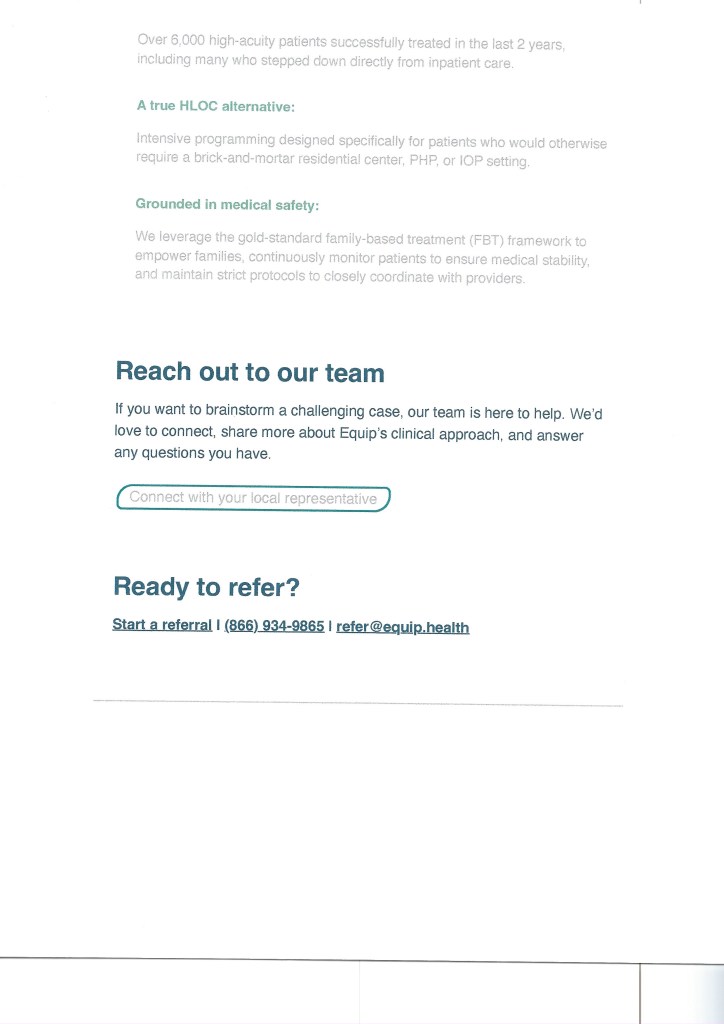
The body of the email makes the subject line harder to dismiss. Equip tells providers that it is a “common misconception” that virtual eating disorder care is only for less complex patients seeking IOP or outpatient treatment. It says patients who are medically, psychologically, or socially complex, or recently hospitalized, can receive the structured support they need through Equip. It describes the company’s 100 percent virtual model as a direct alternative to residential treatment, PHP, and IOP. It claims more than 6,000 high acuity patients successfully treated in two years. It invokes medical safety, strict protocols, and the gold standard of family-based treatment.

Each phrase is material. Together, they create a net impression: Equip is not merely offering virtual outpatient care. It is positioning its model as a substitute for higher levels of care, including for patients described as high acuity or even highest acuity.

That is where the substantiation problem escalates.

FBT has evidence. Virtual FBT has a smaller and less mature evidence base. Equip’s proprietary virtual model is a separate proposition. A fully virtual model marketed as a direct alternative to residential treatment, PHP, and IOP is another proposition still.

In an attempt to gain legitimacy, Equip’s email collapses those categories.

Evidence for in person FBT cannot simply be transferred to virtual FBT. Evidence that virtual FBT may be feasible for selected medically stable patients cannot be stretched into proof that a virtual commercial platform is equivalent to higher levels of care. Company associated outcomes do not become independent validation because the model is built around a recognized therapy.

That is evidentiary laundering. A valid treatment principle is being used to support a broader commercial claim the public evidence has not established.

The existing virtual FBT literature appears to support a narrower statement: virtual FBT may be feasible, acceptable, and useful for selected patients, particularly medically stable adolescents and young adults with adequate family support and access to medical monitoring. That is meaningful. But it is not a finding of equivalence to in person FBT. It is not proof of non-inferiority. It is not evidence that residential care, PHP, or IOP can be replaced for patients who meet those levels of care.

No independent, third party, comparative trial has established that virtual FBT is as effective as in person FBT for adolescent anorexia nervosa. No independent objective trial appears to establish that Equip’s model is equivalent to standard in person FBT. No public independent evidence appears to show that Equip’s fully virtual program is clinically equivalent to residential treatment for patients who meet residential criteria.

Yet the email calls the model a direct alternative.

A direct alternative requires direct proof.

Residential treatment, PHP, and IOP are not interchangeable marketing categories. Each level exists because certain patients need more structure than ordinary outpatient care. At the upper end, care may require direct observation, medical stabilization, supervised meals, behavioral containment, psychiatric safety planning, or twenty-four-hour structure. Whether every program performs those functions well is a separate issue. The level of care exists because the functions are clinically necessary for some patients.

Equip’s model may provide real services: therapy, nutrition support, family coaching, medical coordination, remote meal support, protocols, and escalation. Those services can matter. They do not, by themselves, constitute acute care. They do not establish equivalence to residential treatment. They do not prove safe management of the highest acuity patients.

The distinction is not semantic. It is the patient safety line.

Equip’s own public materials reportedly recognize a limiting principle: the company describes its care as appropriate for medically stable patients and indicates that patients are medically cleared before enrollment. That qualifier is decisive. Medically stable step-down care is one proposition. Highest acuity acute virtual care is another.

The email blurs the difference.

“Medically complex” does not mean medically stable. “Recently hospitalized” does not mean ready for virtual care. “Would otherwise require residential treatment” does not mean safe to manage at home. “High acuity” is not an outcome. “Successfully treated” is not evidence unless the terms are defined and the failures are disclosed.

The claim that Equip has treated more than 6,000 high acuity patients in two years demands answers. What counted as high acuity? How was success defined? How many patients were screened but rejected? How many were excluded because they were medically unstable? How many lacked adequate caregiver support? How many dropped out? How many required hospitalizations during treatment? How many stepped up to residential, PHP, IOP, medical inpatient, or psychiatric inpatient care? How many relapsed after discharge? How many were lost to follow up? How many actually met independent residential criteria at the time of referral?

Without that denominator, “6,000 high acuity patients successfully treated” is a marketing plan, not scientific proof.

The phrase “grounded in medical safety” has the same defect. In a virtual model, medical safety depends on selection, exclusion, honest reporting, reliable caregivers, local medical access, timely vitals, timely labs, ECGs when indicated, and rapid escalation. Those dependencies may support appropriate virtual treatment for selected patients. They do not transform a remote program into an acute care setting.

Equip’s email made objective health claims in a commercial referral solicitation. The claims concerned acuity, medical safety, treatment success, and level of care substitution. They were directed to providers who influence where vulnerable patients receive care. If Equip cannot substantiate those claims with competent and reliable evidence specific to the representations made, the email is not aggressive education. It is deceptive health marketing. The same type of marketing the FTC has investigated with other providers in the past.

Commercial context reinforces the need for scrutiny. Equip is a venture backed virtual treatment company operating in a payer sensitive field where facility-based care is expensive and often contested. A virtual alternative to residential treatment is attractive to insurers. It is scalable. It may be cheaper to authorize. It can be framed as modern, accessible, and evidence based. None of that proves misconduct. It explains why broad claims about “highest acuity” and “acute virtual care” require exacting proof.

The public interest is greater because Equip is not operating only in the commercial insurance market. Equip states that more than seven million Medicaid members can access its services, that it accepts Medicaid plans in several states, and that it is working to expand across state Medicaid programs and managed care organizations. If a company markets a fully virtual model as acute care for high acuity eating disorder patients, or as a direct alternative to residential treatment, PHP, and IOP, the question is not limited to whether private families were persuaded by aggressive marketing. The question is whether Medicaid beneficiaries, Medicaid managed care plans, state Medicaid agencies, and public healthcare dollars may be relying on the same claims.

Medicaid participation requires a higher level of public scrutiny. Medicaid patients often have fewer covered alternatives, less access to specialized in person eating disorder treatment, and less practical ability to obtain independent review when a covered virtual option is presented as appropriate. If Equip means medically stable patients who have been screened and cleared for virtual treatment, it should say that with precision. If it means Medicaid patients who would otherwise meet criteria for residential, PHP, IOP, medical hospitalization, or psychiatric hospitalization, it should publish evidence strong enough to support that substitution.

Equip may criticize residential treatment. The residential sector has earned scrutiny. But the flaws of one system do not validate a commercial replacement. A company cannot attack higher levels of care as insufficiently proven, then market its own virtual model as a direct alternative without independent evidence commensurate with that claim.

The burden is simple.

If Equip means medically stable patients appropriate for step down care, it should say that. If Equip means highest acuity patients, it should produce the evidence. If Equip means a direct alternative to residential treatment, PHP, and IOP, it should publish the comparative data.

Produce the independent study showing virtual FBT is noninferior to in person FBT. Produce the independent study showing Equip’s proprietary model is equivalent to in person FBT. Produce the independent study showing a fully virtual model is a safe and effective direct alternative to residential treatment for patients who meet residential criteria. Publish the denominator. Publish exclusion criteria. Publish hospitalization rates. Publish step up rates. Publish dropout rates. Publish adverse events. Publish relapse data. Publish outcomes by diagnosis, acuity, medical risk, purging behavior, suicidality, weight status, prior hospitalization, and caregiver availability.

Until then, the email should be read for what it is: a commercial solicitation asking providers to transition the sickest eating disorder patients into a virtual model on claims Equip has not publicly proved.

Not proof.

Not science.

Not validated acute care.

Merely a sales document. And a sales document worthy of federal agency investigation at that.

A patient refuses breakfast. A parent tries to supervise lunch between work calls. By dinner, food has been hidden, exercise has been concealed, and the number on the home scale depends on whether anyone was watching closely enough. The care team appears by video. The eating disorder remains in the house.

That is the promise and the risk of virtual eating disorder care. Recovery can happen at home only when the home can safely become part of the treatment system.

Equip Health did not enter the eating disorder field quietly. It loudly arrived with a prosecution of the existing system. In Equip’s telling, residential treatment was expensive, disruptive, inaccessible, opaque, and insufficiently evidence based. Families were being asked to send children away. Patients were cycling in and out of facilities. According to Equip’s public rhetoric, families were spending large sums of money on care that did not reliably produce recovery.

That critique landed because much of it contained truth. But shadows and shades of truth also exist in the critique.

First, there is no generally accepted standards of care for eating disorders. A basic, crucial priority. The medical and mental health fields have known about eating disorders for literally decades.  And yet, the eating disorder field cannot collaborate and come up with generally accepted standards of care.  That, in and of itself, is a felony-like indictment against the system and everyone in it.

Eating disorder treatment in the United States is fragmented, expensive, unevenly regulated, and often inaccessible. Many families cannot find trained clinicians. Many insurers deny care until a patient is medically worse. Some residential programs have overpromised, underdelivered, or sold safety without providing it.

But Equip’s argument deserves the same scrutiny Equip applies to residential treatment. Once a company attacks an entire level of care while selling its own substitute, the question is no longer whether the old system has flaws. The question is whether the replacement has proven what it claims.

On that question, the public record is much thinner than Equip’s marketing.

Equip’s model is simple to describe and difficult to validate. It sells virtual, home based eating disorder treatment built around family-based treatment, a multidisciplinary team, peer and family mentors, medical oversight, therapy, nutrition support, and payer reimbursement. It presents this model as evidence-based care delivered without uprooting a patient’s life. It also presents itself as an alternative to the traditional pathway that moves patients among inpatient, residential, partial hospitalization, intensive outpatient, and outpatient care.

And all delivered through the convenience of your laptop screen.

The problem is not that virtual care cannot help some patients. It plainly can. Family based treatment has strong support for adolescents with restrictive eating disorders. Telehealth can expand access. Many families live nowhere near a qualified eating disorder clinician. A home-based model can preserve school, work, family contact, and ordinary life.

The problem is the leap from that defensible proposition to the broader commercial narrative: that a venture backed, payer aligned, virtual platform can stand as a scalable answer to treatment settings that provide supervision, containment, meal observation, and immediate intervention for medically and psychiatrically fragile patients.

Equip has been willing to put residential treatment on trial. Its own record should now be tried.

The Anti-Residential Pitch

Equip’s leadership has publicly criticized residential treatment with unusual directness. Kristina Saffran, Equip’s cofounder and chief executive, wrote that residential settings had become the go to treatment for adults and adolescents despite “no data” on effectiveness. She described watching people cycle in and out of those centers. Equip’s public materials contrast its virtual approach with sending a child away to a residential facility.

Those are not mild statements. They are market positioning. They tell families, clinicians, and payers that residential treatment is not merely costly or unpleasant, but suspect.

That positioning matters because Equip is not an academic critique. It is a company selling the alternative.

When a non-profit advocate says the residential industry needs reform, that is one thing. When a venture backed provider says residential care lacks evidence while asking insurers to pay for its own model, the statement has commercial force. It helps redirect demand. It helps shape payer behavior. It helps define what families are told counts as serious care.

Equip is entitled to criticize residential treatment. But criticism is not proof. A company cannot use the weakness of one sector as evidence that its own model has solved the problem.

The Evidence Gap

Equip’s strongest public evidence appears to be internal or affiliated research, payer reported outcomes, and observational data from patients treated inside its own system. That is not meaningless. It is also not the same as independent proof.

The public record does not show an independent randomized trial proving that Equip’s proprietary five-person virtual model is equivalent to residential treatment, partial hospitalization, or intensive outpatient care for high acuity eating disorder patients. It does not show long term independent relapse data sufficient to support sweeping claims about durable recovery. It does not show that virtual care can safely replace higher levels of care for patients who need supervision, structure, meal support, bathroom monitoring, medical stabilization, or emergency psychiatric containment.

Equip’s studies may show improvement among selected patients. But selection is the issue. Who was admitted? Who was excluded? Who dropped out? Who was hospitalized? Who stepped up to a higher level of care? Who deteriorated? Who was lost to follow up? Who had caregiver support strong enough to make the model work? Who did not?

A treatment model built around home supervision depends on the home. That is not a minor variable. It is the model.

Equip can say its approach is adapted from evidence-based, family-based treatment. However, that does not establish that every expansion of the model, every diagnosis treated, every acuity level accepted, every payer pathway created, and every substitution for facility-based care is equally proven. The public studies do not appear to answer the hardest question: not whether some patients improve with Equip, but whether patients who would otherwise need a higher level of care are safe and adequately treated when routed into a virtual platform.

That distinction is the center of the case against Equip’s public narrative.

The Home Becomes the Facility

Equip’s model does not merely treat patients at home. It turns the home into the treatment site.

That shift is profound. In residential care, staff are tasked to monitor meals, watch for purging, interrupt compensatory behavior, respond to refusal, observe medical deterioration, and provide containment. In Equip’s model, that burden moves into the household. Parents and caregivers become meal supervisors. Families become behavior monitors. Home scales become clinical instruments. Kitchens, bedrooms, bathrooms, grocery stores, and exercise routines become part of the treatment environment.

That can work in the right family. It can also fail for reasons that have nothing to do with motivation. Some parents work jobs that do not allow meal supervision. Some households are divided by divorce, conflict, poverty, addiction, violence, illness, or exhaustion. Some patients are adults whose families have no legal or practical control. Some caregivers are too frightened, too traumatized, too clinically naive, or too financially strained to perform the job the model assigns to them.

Recovery at home is a clinical model only when the home can safely become a clinic.

That is the part of the promise families need to hear clearly. Virtual treatment is not simply a more humane version of higher care. It is a transfer of clinical labor into the household. If Equip excludes patients whose homes cannot support that transfer, its model is narrower than its public rhetoric. If it accepts them anyway, the safety questions become more serious.

The Business Model Behind the Clinical Claim

Equip’s financial structure sharpens the concern. Public releases and reports identify F Prime Capital, Optum Ventures, .406 Ventures, The Chernin Group, Tiger Global, General Catalyst, Katie Couric Media, and Alex Morgan among Equip’s publicly named investors, with Kerry Washington later announced as an advisor and investor. Equip’s public and regulatory record also shows substantial later equity financing: a 2024 Form D amendment reported approximately $35 million sold to five investors, and a September 2025 Form D amendment reported approximately $54.1 million sold to twelve investors. Those later Form D filings do not publicly identify the investors.

That capital does not come without expectations. Venture backed health care companies are not built to remain small, cautious, and slow. They are built to scale. Scaling a virtual eating disorder provider means adding lives, adding states, adding payer contracts, expanding diagnoses, increasing referrals, standardizing protocols, and demonstrating that care can be delivered at lower cost than facility-based treatment.

Again, none of that is inherently improper. But it creates pressure. And in health care, pressure travels.

It travels into admission criteria. It travels into marketing claims and payer conversations. It travels into outcome metrics. It travels into decisions about which patients can be treated virtually and how long a company waits before recommending a higher level of care.

The Optum Ventures investment is especially important. Optum Ventures led Equip’s Series A offering. Optum is part of the UnitedHealth Group ecosystem, one of the most powerful payer and health services structures in American medicine. Equip also publicly identifies UnitedHealthcare and Optum among insurance plans connected to coverage. A payer connected investor in a virtual model that can reduce use of residential or partial hospitalization care is not proof of misconduct. It is, however, a bright red discovery target.

The question is direct: Was Equip marketed to payers as a clinically superior model, a lower cost substitute, or both?

Aetna’s public discussion of its value-based arrangement with Equip adds weight to that question. Aetna described the collaboration as a way to standardize outcomes, reduce disruption, and control costs. It reported patient progress and symptom reductions among Aetna members treated by Equip. It also framed the arrangement as a value-based success.

That may be good payer management. It may also be the precise place where clinical judgment and cost containment begin to blur.

The broader question is not limited to Optum or Aetna. Who benefits when higher levels of care are avoided? Payers benefit from fewer residential, PHP, and IOP claims. Virtual providers benefit from payer referrals. Investors benefit from scalable treatment with lower facility costs. Families may benefit when virtual care is clinically appropriate. But patients may be harmed when a lower cost model substitutes for needed containment.

If a patient is routed to Equip because virtual care is clinically appropriate, that is one thing. But, if a patient is routed to Equip because residential or partial hospitalization is expensive, difficult to authorize, or disfavored by the payer, that is another. The public record does not answer that question. It demands that the question be asked.

What Virtual Care Cannot Do

Equip’s model rests on an appealing premise: recovery should happen in real life. But eating disorders often thrive in real life. They hide in bathrooms, bedrooms, kitchens, grocery stores, exercise routines, laptops, family conflict, secrecy, shame, manipulation, and medical instability. The disorder is not merely a thought pattern that can be discussed over video. It is behavior, physiology, risk, concealment, and control.

Virtual care cannot sit at the table for every meal. It cannot watch a patient after dinner. It cannot prevent purging in the bathroom. It cannot stop compulsive exercise in the bedroom at midnight. It cannot verify every weight. It cannot take vital signs unless someone reliable takes them. It cannot create a safe household where one does not exist. It cannot supply twenty-four-hour containment when a patient is suicidal, medically unstable, actively restricting, purging, fainting, manipulating weight, or refusing food.

Medical instability is not a branding problem. It can mean bradycardia, orthostatic instability, electrolyte disturbance, dehydration, syncope, refeeding risk, laxative abuse, acute self-harm, or suicidality. Those risks do not become manageable because treatment is convenient. They require accurate detection, rapid escalation, and honest limits.

Equip can respond that those patients require hospital stabilization or a different level of care. That answer is clinically necessary. It also narrows the model. It means Equip’s public promise depends on careful exclusion, rapid escalation, and honest recognition of what virtual care cannot safely manage.

That is where the public rhetoric becomes dangerous. The broader the attack on residential care, the easier it becomes for families and payers to hear that higher care is outdated, excessive, or unnecessary. The broader the claim that recovery can happen at home, the easier it becomes to underestimate the patients for whom home is not a treatment setting. It is the site of the illness.

The Missing Denominator

Equip and its payer partners have reported favorable outcomes. But every outcome claim in behavioral health lives or dies by its denominator.

How many patients entered treatment? How many completed it? How many left early? How many required hospitalizations? How many stepped up to residential, PHP, or IOP? How many had emergency interventions? How many relapsed six months later? How many were excluded before admission because they were too medically unstable, too psychiatrically acute, too unsupported at home, or too difficult to monitor? How many families could not perform the work the model requires?

Without that denominator, success rates risk becoming marketing assets rather than scientific findings.

This is especially important because Equip has criticized residential treatment for cycling patients through care. If Equip wants to make relapse, readmission, and revolving door treatment part of the indictment against residential providers, then Equip must disclose comparable data for its own model. Not just symptom improvement among engaged patients. Not just progress among payer members. Not just weight restoration among those who remained in care. The complete denominator.

The public record does not yet supply that level of independent validation.

What Would Prove Equip Right

Equip could answer much of this criticism with evidence. Not slogans. Not affiliated outcome summaries. Not payer success stories. Evidence.

Independent randomized or well-matched comparative studies would matter. Full denominator reporting would matter. As would comparable acuity groups. Long term relapse and readmission data are material. Adverse event reporting and transparent hospitalization and step up rates matter. Independent replication by researchers without financial ties to Equip are imperative. Payer savings data separated from clinical outcomes. Clear criteria for patients who met residential level of care but were treated virtually must be disclosed.

That is what proof looks like.

Until then, Equip has not disproven residential treatment. It has built a business arguing that many patients should not need it.

The Real Indictment

Equip’s vulnerability is not that virtual care never works. That would be false and unserious. The vulnerability is that Equip has built a business around a claim that needs far more independent proof than the public record appears to provide.

Equip has criticized private equity owned residential treatment while raising venture capital. It has presented home based virtual care as evidence based and scalable. It has partnered with insurers in arrangements that explicitly include cost control. It has accepted investment from a payer connected venture fund. It has published or promoted favorable outcomes while the hardest questions about exclusion, dropout, escalation, relapse, adverse events, and long-term recovery remain unresolved in the public domain… and undisclosed.

The issue is not whether Equip is another false hope story to desperate families. The story is that Equip is a test case for a larger transformation in American behavioral health: the conversion of complex, high risk care into virtual, scalable, payer friendly products.

That transformation may improve access for some patients. It may also produce a cheaper treatment pathway that looks most successful when the sickest, least supported, hardest to monitor patients are filtered out, stepped up, or missing from the denominator.

The eating disorder field has already seen what happens when treatment is sold faster than it is proven. Families are desperate. Insurers are cost conscious. Investors want growth. Clinicians are scarce. Patients are vulnerable. In that environment, the company that claims to have solved access, cost, evidence, and continuity deserves heightened scrutiny precisely because the promise is so attractive.

Equip put private equity owned residential treatment on trial. Now, Equip should produce the evidence for its own case.

Publish the full denominator. Publish step up rates. Publish hospitalization rates. Publish adverse events. Publish dropout data. Publish relapse data. Publish payer savings data. Publish the criteria used when patients met residential level of care but were treated virtually. Publish the conflicts.

Then the field can judge whether Equip has built a breakthrough. Or merely a scalable workaround for expensive care.

Gratitude for ?

In years past — usually every November — Sierra Tucson and its Overlord and Master, Acadia Healthcare, would descend upon the Dallas–Fort Worth area to host their annual “Gratitude for Giving” Event.

This event purported to honor individuals and organizations making a positive impact in the mental health community. A noble endeavor, at least in theory — recognizing the resilient, compassionate mental health professionals who do thankless work while corporate giants circle overhead, feeding off their labor.

So without further ado, let’s get to this year’s honorees. They are …

Uh … well … uh…

Make no mistake: North Texas is overflowing with mental health heroes who deserve recognition — especially the ones humble enough to insist they are not worthy of it.

And yet, Acadia chose to honor …

That is undoubtedly due in large part to the fact that Acadia is not hosting a Gratitude for Giving Event in North Texas this year.

Why? Oh, the reasons are plentiful. Embarrassingly plentiful.

It could be that Acadia’s once-respectable stock price — around $82 per share in September 2024 — is now living, if one can call it that, on life support at a pathetic $15.00. That’s not a dip; that’s a financial face-plant. Ouch.

It could be the ongoing Department of Justice fraud investigation that refuses to die … much like the problems Acadia keeps pretending don’t exist. Nothing says “gratitude” like having federal agents rummaging through your corporate laundry.

It could be in November 2025, Acadia shelled out a cool $179 million to settle one of the many fraud lawsuits brought by its own shareholders. When your investors sue you, you know you’ve achieved a special level of corporate rot.

It could be the numerous other pending lawsuits against Acadia owned entities for allegedly physically and sexually abusing people entrusted to its care(?).

It could be the abrupt closure of multiple Acadia facilities over the past year — not because they suddenly discovered ethics, but because the abuse was too egregious or the profits weren’t fat enough. Facilities like Options Hospital, Carolina House, Timberline Knolls, Montecatini.

It could be the number of victims under the “watchful” eye of Acadia who died at their facilities.

It could be the fact that the Department of Veteran’s Affairs is investigating Acadia for allegedly engaging in Medicaid fraud.

It could be that shareholders have filed other fraud lawsuits against Acadia alleging that Acadia engages in medically unnecessary involuntary hospitalization of psychiatric patients. Because nothing says “healthcare” like trapping people to bill insurance.

It could be that Acadia’s methadone clinics are under investigation for falsifying medical records to meet productivity quotas — and billing insurers and Medicaid for therapy sessions that never happened. Productivity over people, as always.

It could be that in June 2024, the US Senate issued a scathing report regarding Acadia and 3 other entities alleging in part that vulnerable children are being used as pawns to maximize the profits of these facilities – and American taxpayers are footing the bill. The report further states, “More often than not, these kids aren’t even getting the basic care they need and instead are in many cases experiencing serious neglect and abuse.”

This is not a wave of bad publicity. It is a tsunami of scandal, abuse, fraud, and moral bankruptcy. And so Acadia — desperate for even a flicker of positive PR — chooses to honor…

Shouldn’t we wonder why? Is it because its head isn’t screwed on just right? Could it be perhaps, that its shoes are too tight? But, perhaps the most likely reason of all … is that its heart is two sizes too small!

But let’s drop the Seussian metaphors for a moment. We all know the real reason.

When an entity places profits over patient care, the inevitable results are mistreatment, abuse and tragedy. At its quarterly shareholders’ meetings, the number of beds are discussed, quarterly revenue, adjusted EBIDTA, capital expenditures, market trends, and issues pertaining to its revenue. What is not discussed is the lack of QUALITY care given, the harm to families it is causing, the abuse, or how the lack of oversight of its facilities is being addressed.

Life and death issues being cavalierly dismissed. After all, we can’t let a few deaths and some abuse detract from Acadia’s CEO’s annual salary of $7 million! That daily paycheck of $19,178.00 needs to keep rolling in!

With this long history of abuse, assault, fraud, unethical profiteering, lack of transparency, shuttering facilities and gross mismanagement, who should be referred to any Acadia facility?

Sadly, that will not stop eating disorder organizations from continuing to accept Acadia’s dirty money and marketers continuing to refer families to Acadia’s chambers of abuse … More’s the pity.

HOW TO FIGHT DENIAL OF YOUR HEALTH INSURANCE CLAIM

An insurance company denying your legitimate, desperately needed health insurance claim has become all too common, an ordinary way of life … and a large profit center for those insurance companies.

Finally one attorney, Brian Hufford, has dedicated his practice to addressing this widespread problem. But first, let’s look at the alarming statistics.

In 2023, insurers on the HealthCare.gov marketplace denied an average of 19% of in-network claims and 37% of out-of-network claims. Denial rates varied widely by insurer, ranging from as low as 1% to over 50%.

Surprisingly, the most common reason for denial isn’t related to medical necessity at all. A full 34% of denials fall under the nebulous category of “Other”—an unspecified catch-all that gives insurers maximum flexibility and patients minimum clarity. When these vague denials are appealed, they’re overturned approximately 55% of the time, suggesting that the majority have no solid justification.

Administrative issues account for another 18% of denials. These include coding errors, missing information, or duplicate claims—technical issues having nothing to do with whether the care was appropriate or covered under the policy. These denials have the highest overturn rate at 78%, as they’re often simple misunderstandings or clerical errors that can be easily corrected.

Claims categorized as “service not covered” make up 16% of denials. While these have a lower overturn rate of about 35%, successful appeals often demonstrate that the service actually does fall under covered benefits when policy language is properly interpreted or when the medical necessity is clearly established.

Prior authorization issues cause 9% of denials, with patients receiving care without getting the insurer’s permission first. These have a 65% overturn rate when appealed, particularly when the care was urgently needed or when the provider can demonstrate they attempted to secure authorization.

Perhaps most concerning are the “not medically necessary” denials, which represent 6% of cases. These denials essentially second-guess your doctor’s judgment about what care you need. Yet when patients and their doctors challenge these determinations, they succeed approximately 70% of the time—an alarming discrepancy that raises questions about how these decisions are made in the first place.

Despite these high denial rates, fewer than 1% of denied claims are ever appealed by consumers. A survey found that 85% of patients never file a formal appeal, often due to a lack of awareness of their appeal rights or the complexity of the process.

When consumers and providers do appeal, they have a strong chance of success. According to a recent KFF survey, patients who took the time to appeal their denials experienced a 44% success rate with initial internal appeals—meaning nearly half of all challenges succeeded in the first round. For those whose internal appeals were rejected and who proceeded to external review, an additional 27% succeeded at that level.

When healthcare providers manage the appeal process, over 54% of initially denied claims are ultimately paid after multiple rounds of review. Some sources suggest that up to 80% of appeals can be successful when pursued effectively.

In summary, despite the fact that while claim denials are common, and patients and providers who navigate the appeals process often succeed in getting the denial reversed, the vast majority of denials go unchallenged. 

The 2023 KFF Survey of Consumer Experiences with Health Insurance found that 58% of insured adults said they have experienced a problem using their health insurance, including denied claims. Four in ten (39%) of those who reported having trouble paying medical bills said that denied claims contributed to their problem.

Each denial costs medical practices, on average approximately $43 to process, creating over $19 billion in administrative waste annually across the healthcare system. Small practices often spend more than 12 hours weekly wrestling with insurance companies over denied claims.

By making the process difficult and opaque, they ensure most people simply give up and pay out-of-pocket, or worse, forgo necessary medical care altogether. The financial result is billions in unpaid claims that boost insurance company profits while shifting costs to patients.

And at least one man, one attorney has had enough. Brian Hufford was one of the lead attorneys in the Wit v. UBH case still pending in California.

Briefly, David Wit along with other insureds brought a class action lawsuit challenging United Behavioral Health’s (UBH) use of flawed, financially motivated internal guidelines to deny coverage for mental health and substance abuse treatment, rather than applying generally accepted standards of care. The district court initially found during a class action trial that UBH violated the terms of its health insurance policies and breached its fiduciary duties under ERISA, ruling that UBH’s internal guidelines were defective and more restrictive than generally accepted standards of care. The Court of Appeals reversed this decision on the benefit claim and dismissed those class claims but sent it back to the district court to determine if the fiduciary duty findings should remain. Upon reconsideration, the district court again found that UBH breached its fiduciary duties. The case is on-going.

Despite that case still being active, Brian left his firm to start his own practice. After spending a career founding and running health insurance dispute practices at private firms, representing patients and clinicians against insurance companies, Brian opened his own practice as of July 1, 2025, to focus on public policy and advocacy.

His primary work is to expand help for people appealing health insurance denial. As the statistics show, this is a service that is wholly lacking in our current system. To address this matter, Brian is working with law schools to provide pro bono opportunities to law students who assist with health insurance appeals, working under his supervision. He is coordinating this effort through the People’s Action nonprofit, which is pursuing a Care Over Cost campaign, and Brian is serving as legal advisor to its National Appeals Team. Brian is also working as Senior Legal Advisor to Claimable, Inc., a start-up that is using AI to systematize health insurance appeals (www.getclaimable.com/).

If you have people who have been subjected to denials and need help with appeals, feel free to contact Brian (which is pro bono through his law school project). Depending on the number of patients who reach out, he may also connect people to Claimable for assistance.

Brian’s website is below, which has a link to a form patients can fill out. The form is automatically forwarded to Brian, and he will then follow up. You can contact Brian with any questions you may have.  

This crucial resource for our families is so incredibly important. And could very well mean the difference between you getting the necessary care you or your loved one need versus suffering from an unjust system.

Embrace a better future.

For more information, go to:

About Us

LIVE OR DIES … Ai DECIDES

Your 18-year-old daughter, who is struggling with severe anorexia, desperately needs a higher level of care. Biologically, her organs are failing. You make a claim with your health insurance company. And you receive a denial.

You quickly research and then discover an Ai program utilized by the insurance company made the decision to deny saving your daughter’s life.

Welcome to the world in which we live. Where Ai programs may be making life and death decisions about your loved ones. That is the very harsh reality. So, let’s explore that reality.

First, what is “artificial intelligence?” The term itself is so vague as to be mystifying. What makes it artificial? The fact that human beings invented it? That it is silicone based instead of carbon based? Is the programmed intelligence, which is designed to learn at a rate far faster than humans can possibly comprehend, deemed artificial because it lacks a sentient existence?

Is Ai artificial because whereas it may “learn,” it does not experience the subtle nuances and life experiences which make us all unique? Does Ai have a soul? For that matter, do we?

Regardless, with Ai still being in an early stage of development, and with Ai’s developing interaction with humans, we must find ways to build guard rails so that Ai is not in a position where it could singularly make life and death decisions. Decisions which are often made by health insurance companies when deciding to pay, or not pay, for life saving surgeries or treatment. Or is it already too late?

Imagine if you will, an Ai program being utilized, without human interaction, to review and decide a claim or an appeal of a claim for a higher level of care, or to receive necessary treatment or to receive a life-saving procedure. An Ai program with no human experiences, no ethics, no soul, no subtlety, no morality. To leave our very existence in the hands of a machine, a machine that cannot love, cannot experience sorry, or joy, or happiness, or despair. And yet … that is happening. Today.

In 2020, UnitedHealth Group division Optum acquired naviHealth and its algorithm for predicting care, called nH Predict, which UnitedHealth uses and contracts out to other insurers, including Humana. Multiple industry sources estimate that Optum paid at least $1.1 billion dollars and when considering debt and related financial structuring—the purchase price is estimated to be as high as $2.5billion. When asked by the Guardian, a spokesperson for UnitedHealth Group denied that the algorithm is used to make coverage decisions. [Like when UBH denied it ran its guidelines through its accounting and finance departments?] 

UnitedHealth, Humana and Cigna are facing class action lawsuits alleging the insurers unethically relied upon Ai generated algorithms to deny lifesaving care.

One of the lawsuits alleges that Cigna denied more than 300,000 claims in a two-month period. This equates to spending approximately 1.2 seconds for each presumably physician-reviewed claim. Such a practice is aided by algorithms, the lawsuit alleged.

The Cigna lawsuit also alleged that nH Predict had a 90% error rate, meaning nine out of 10 denials were reversed upon appeal – but that vanishingly few patients (about 0.2%) appeal their denied claims, leading them to pay bills out of pocket or forgo necessary treatment.

Appealing denied claims means big business. The US Centers for Medicare and Medicaid Services estimate that when insureds appeal initial denials administrative costs for insurance providers exceed $7.2 billion annually.

According to a United States Senate Report issued in October 2024, UnitedHealthcare, CVS and Humana – the three largest providers of Medicare Advantage, together provide almost 60% of all Medicare Advantage coverage – but reject prior authorization claims at higher rates using technology and automation. That report can be found here:

To support the implementation of Ai, health insurance companies argue that Ai programs streamline claims processing, more effectively flag fraud, and promise greater speed, efficiency and cost savings.  They claim that by automating routine claims, Ai frees up human reviewers to focus on complex or borderline cases that require medical judgment and nuance. (For that matter, don’t all claims require medical judgment?)

Despite its alleged advantages in claims processing, Ai has faced fierce criticism, especially when its role extends to denying coverage or appeals for essential care. Ai is not immune to flaws, as its decisions depend on data quality and programming — both of which can perpetuate mistakes or systemic biases. Garbage in Garbage out.

Many Ai systems operate opaquely, leaving patients, providers, and even insurers unsure how specific decisions are made. This undermines trust and impedes meaningful appeals.

Numerous lawsuits allege that Ai tools prioritize cost-saving over medical necessity. In some cases, Ai has overridden physician recommendations, resulting in denials of rehabilitation, mental health services, or life-saving treatments.

There is a widespread perception—and often a harsh reality—that health insurers prioritize profits above the needs of their insureds. Ai tools, by automating denials or aggressively limiting coverage, can exacerbate this distrust, especially when decisions feel impersonal or unjust.

Critics argue that Ai systems are often deployed as “rubber stamps,” with little or no meaningful physician review—contravening legal and ethical obligations.

Meanwhile, states like California have moved to ban Ai-only coverage denials, signaling a wave of regulatory intervention.

As for those health insurance companies which utilize Ai alone to decide claims or appeals, the major issues focus on:

Risk of Profit-Driven Bias: Ai tools influenced by financial priorities may embed cost-saving incentives that override medical necessity, echoing problems revealed in the Wit v. UBH case.

Lack of Clinical Nuance: Ai lacks the ability to fully understand complex medical contexts or patient histories that human clinicians evaluate.

Transparency and Accountability: Patients have a right to clear explanations and meaningful appeals, which Ai-alone systems often fail to provide.

But that is where we are. Ai is being utilized by insurance companies to decide claims and appeals. Although the insurance companies may deny this fact, it is a reality. Especially since widespread use of Ai in denying claims and appeals will result in much greater profits for these companies.

To counter this reality, the future must be shaped by the following:

Stronger Regulatory Frameworks

States and potentially federal regulators are developing rules to ensure Ai complements—not replaces—human medical judgment. Requirements for physician involvement, transparency, and appeal rights are expected to expand.

Increased Legal Scrutiny

As lawsuits proceed, courts will clarify the legal boundaries of Ai’s role in coverage decisions, particularly under ERISA, Medicare Advantage rules, and consumer protection laws.

Pressure for Transparency and Explainability

Insurers may face mounting demands to disclose how Ai tools function, how decisions are made, and how patients can challenge automated denials.

Smarter, More Ethical Ai Development

Future Ai systems may incorporate safeguards to avoid wrongful denials, improve alignment with medical standards, and enhance explainability.

Ai’s exploding involvement, or interference in our lives will only increase. That is inevitable.

There is the potential that Ai can make health insurance claims processing faster, fairer, and more efficient—but only if deployed responsibly. It must address not only human fallibility but also the systemic distrust stemming from the reality that insurers prioritize profits over patients. Lessons from Wit v. UBH remind us that financial influence over clinical decisions can have devastating consequences, a cautionary tale for Ai implementation.

As courts, lawmakers, and the public demand accountability, the health insurance industry faces a pivotal choice: embrace Ai as a tool to support—not supplant—human expertise, or risk eroding trust and facing costly legal consequences.

The future of Ai in health insurance is not just a technological issue—it is a legal, ethical, and societal issue. Right now, the live of your loved one may very well depend on a machine. On Ai. A lifeless, soulless computer program devoid of all emotion, mercy and humanity.

That is our reality right now. Allow yourself to contemplate that reality and perhaps yes, be afraid. For our future depends on wisdom far greater than humanity has ever demonstrated. Our health depends on it. Our very lives depend on it.

ACADIA’S TRAIL OF VICTIMS

Recent articles highlighted the many legal and financial issues plaguing Acadia Healthcare. Upon further research, additional legal and financial issues have come to light.

Lawsuits

There are now at least three lawsuits filed by disgruntled, angry investors. These lawsuits claim as a matter of its business practices and on a corporate wide basis, Acadia perpetrated fraudulent acts and engaged in acts of misconduct and malfeasance.

The oldest lawsuit was filed in 2018 by the St. Claire County Employees Retirement System on behalf of themselves and a class of other investors. The lawsuit alleges that throughout and before the Class Period,  Acadia, its officers and Board of Directors engaged  in  a  scheme  to  defraud  and  mislead  investors  concerning  patient  care,  staffing  levels,  and  legal  compliance  issues. Acadia has vigorously defended the case.  The Court granted class certification and the case is expected to go to trial in 2025.

Two other cases were filed in October 2024 after: Acadia was eviscerated by the Senate Finance Committee in a damning report in June 2024; the New York Times published a comprehensive article evidencing that Acadia was committing many wrongful and/or unethical acts towards patients; Acadia agreed to pay a $19.8 million fine to the Department of Justice and three states; Acadia agreed to pay another $1.38 million to the United States because of Acadia’s misconduct directed toward employees, and; the Veteran’s Administration announced it is conducting its own investigation into Acadia.

These cases were filed against Acadia, its CEO and CFO and prior CEO and CFO.  Amongst other claims, the lawsuits allege misrepresentation and fraud.

If found liable, Acadia could be forced to satisfy judgments in the hundreds of millions of dollars.

Administrative Fines

In September 2024, Acadia agreed to pay $19.85 million dollars to the United States for knowingly submitting false claims for payment to Medicare, Medicaid and TRICARE for inpatient behavioral health services that were not reasonable nor medically necessary.

Acadia also agreed to pay $1,386,000 to the Securities Exchange Commission pursuant to a Cease and Desist Order entered on September 9, 2024. In this investigation, the SEC found that Acadia had, as a matter of its employment practices, violated rules permitting whistleblowers to receive a reward payment for reporting Acadia’s employment practices to the appropriate federal agency. Acadia also required some of its departing employees to waive their right to file a complaint with any federal government agency.

These provisions created impediments to participation in the SEC’s whistleblower program by requiring employees to forego either their right to file a complaint with the Commission staff or the financial award they might receive for doing so. Through this conduct, Acadia violated SEC Act Rule 21F17(a), which prohibits any person from taking any action to impede an individual from communicating directly with the Commission staff about a possible securities law violation.

These agreements were signed by former employees 56 times between 2019 and 2023.

The Veteran’s Administration announced it was proceeding with its investigation into Acadia for violating laws pertaining to Tricare.

In May 2019, Acadia agreed to pay the federal government $17 million to settle allegations it defrauded Medicaid in West Virginia. The federal government alleged that a subsidiary [CRC Health, L.L.C.] of Acadia which owns seven drug addiction treatment centers in West Virginia, defrauded Medicaid over several years through false claims for laboratory tests related to the opioid epidemic.

Since 2000, Acadia has paid approximately $49,000,000 in fines to federal and state agencies for its egregious conduct.

Other Governmental Investigations

As previously stated, a Senate Committee Report and the New York Times (twice) eviscerated Acadia for its business practices.  On October 3, 2024, Adam Schiff, Senator-elect from the State of California, sent a letter on Congressional letterhead to Acadia demanding answers to eight (8) questions addressing a number of the improprieties.

One of these questions was, “Tim Blair, an Acadia spokesman, has publicly acknowledged that Acadia has deployed employees, referred to as “assessors,” throughout nearby hospital emergency rooms to support hospital staff. What specific services do assessors provide? What education-level and qualifications are required to work as an assessor? What specific training is provided to assessors by Acadia?”

The next day, October 9, 2024, Ron Wyden, Chair of the Senate Committee on Finance sent a letter to Attorney General Merrick Garland, requesting that the Department of Justice begin an investigation into the facts set forth in the Senate Report.

Private Lawsuits

In 2019, a lawsuit was filed against amongst other defendants, Acadia Healthcare. In that lawsuit, a guardian of an adolescent accused the Acadia companies of failing to protect a young girl under their care. The filing states that an employee of one of Acadia’s subsidiary companies repeatedly raped the child in 2018. The jury awarded the plaintiff $485 million dollars in damages.  Acadia initially stated it would challenge the jury verdict.

Instead, Acadia paid the plaintiff $400 million. $400,000,000.00!

There are at least four (4) lawsuits filed against Acadia and Timberline Knolls and criminal cases pending against Michael Jacksa, a former Timberline Knolls counselor.  Jacksa sexually assaulted at least six (6) patients at Timberline Knolls.

In 2018, Acadia through its wholly owned subsidiary, Ascent Children’s Health Services announced it was closing all ten (10) locations in the State of Arkansas. This closure displaced nearly 1700 children.

The closures were announced after the settlement of a Crittenden County Circuit Court civil lawsuit filed in July 2017 by Ashley Smith, mother of 2-year-old Christopher Gardner. Christopher died June 12, 2017, after being left in a transport van at the West Memphis facility for eight hours. Ascent workers signed documents showing that Christopher was taken inside the West Memphis day care center, even though he remained on the van.

Kendra Washington, Felicia Ann Phillips, Wanda Taylor and Pamela Lavette Robinson, all former Ascent employees were charged with felony manslaughter in Christopher’s death. 

In August of 2024, a civil case was filed alleging that one of Timberline Knolls employees raped a patient in May of this year. A law firm based in Indianapolis represents at least (7) patients who were abused at the hands of Acadia. At least three of these cases are pending in state courts in Indiana and substantiate the allegations made against Acadia.

Now, a former patient of Acadia from Texas has come forth. She alleges the same reprehensible conduct perpetrated by Acadia at other facilities was directed against her. And … I have the honor and privilege of co-counseling with that Indiana law firm to pursue her rights here in Texas.

For those who continue to deal with Acadia (as is your right), for those who continue to accept Acadia’s money, you may wish to review the definition of “dirty money.”

For that money came from patients who were wrongfully held against their will, from patients who were held for the sole purpose of increasing the profit margin of Acadia, from patients who did not receive adequate care or treatment, from patients who were abused and in some cases, sexually assaulted or raped. From patients who died at the hands of employees of Acadia.

And to those organizations which have accepted thousands of dollars from Acadia entities, organizations which have actual knowledge of Acadia’s wrongful conduct, organizations with so called ethics committees but who do nothing … NOTHING … to demand accountability or assess consequences … when you look into a mirror, that death mask reflected back is the visage of your acquiescence, your acceptance and your guilt.

Timberline Knolls

Dante’s seminal work, “The Divine Comedy,” is regarded as one of greatest writings in Western Literature. It is divided into three parts: Inferno, Purgatorio and Paradiso.

This literary masterpiece discusses “the state of the soul after death and presents an image of divine justice meted out as due punishment or reward” as it describes Dante’s travels through Hell, Purgatory and Heaven. There are nine circles of the Inferno, or Hell, followed by Lucifer contained at its bottom.

We now know there is a tenth level not addressed by Dante.  This level is Timberline Knolls in Lemont, Illinois. 

On August 21, 2018, Michael Jacksa, then a counselor at Timberline Knolls was arrested and charged with assaulting a 29 year old patient at Timberline Knolls during two counseling sessions between May and June of 2018. 

Jacksa was accused by patients of digitally penetrating their vaginas and buttocks, putting his hands beneath their clothing, fondling their breasts and forcing them to give him oral sex. During his first bond hearing on Aug. 21, Jacksa reportedly admitted to police that he “probably went too far.”

This “probably went too far” conduct manifested itself by him being indicted for his reprehensible conduct directed toward a second victim. According to those charges, between Dec. 1, 2017 and Jan. 10, 2018, Jacksa was treating an out-of-state woman for eating disorders, anxiety and past sexual abuse. The patient alleges that Jacksa sexually assaulted her during four therapy sessions at Timberline Knolls. The prosecutor said the second woman came forward after seeing media reports.

According to the prosecutor, at least six other former patients of Jacksa’s from across the country have contacted the Lemont Police Department stating that Jacksa allegedly engaged in “inappropriate sexual behavior” during their respective therapy sessions.

But that is not the end of Timberline Knolls and Acadia’s problems.  Not nearly.

On September 1, 2024, a New York Times report published a scathing article about Acadia Healthcare, the publicly traded company which owns Timberline Knolls. The article and its follow up can be found here:

In short, the New York Times report indicated that Acadia Healthcare allegedly held patients longer than was necessary and often against their will at certain facilities. The report also claims Acadia trumped up patient symptoms in reports to payers to extract more reimbursement. The Report stated: “Acadia has exaggerated patients’ symptoms. It has tweaked medication dosages, then claimed patients needed to stay longer because of the adjustment. And it has argued that patients are not well enough to leave because they did not finish a meal,” the New York Times alleged. “Unless the patients or their families hire lawyers, Acadia often holds them until their insurance runs out.” 

This Report allegedly included at least 12 of the 19 states where Acadia operates psychiatric hospitals. Dozens of patients, employees and police officers notified authorities that the company was detaining people in ways that broke the law, the report stated, citing records. It is unknown whether Timberline Knolls is part of that conduct.

Acadia stated the assertions are inaccurate.

But that is not the end of Timberline Knolls and Acadia’s problems.  Not nearly.

The United States Committee on Finance conducted a two-year study of four major companies providing mental health services to children and adolescents.  One of the four companies? Acadia Healthcare.

The findings of that study were released on June 12, 2024.  The study can be found here:

The testimony before the Committee and the Exhibits supporting the study can be found here:

https://www.finance.senate.gov/hearings/youth-residential-treatment-facilities-examining-failures-and-evaluating-solutions

The study’s findings can be summarized as follows:

  • Children suffer routine harm inside Residential Treatment Facilities (“RTF”). The risk of harm to children in RTFs is endemic to the operating model. 
  • Children inside RTFs often do not get the treatment they need for mental and behavioral health needs, despite RTFs being reimbursed with federal dollars to provide intensive services. 
  • Horrific instances of sexual abuse persist unremediated inside RTFs. 
  • The use of restraint and seclusion in RTFs allows for unchecked abuse. RTF staff have too often ignored federal restraint and seclusion regulations, resulting in daily use of restraint and seclusion in some instances.  
  • RTFs often employ unqualified or inadequately trained staff and that staff routinely fail to discharge their duties. RTF staffing failures have led to tragic incidents, including child fatalities, and childrens’ repeated exposure to risk. 
  • RTFs are often non-homelike environments, exposing children to unsafe and unsanitary conditions. 
  • RTFs often fail to effectively maintain connections between children and their communities and to plan for childrens’ discharge to the community for ongoing care. 
  • RTFs often employ carceral technology to monitor children, creating environments that feel more like detention facilities than therapeutic settings. 
  • State and federal oversight authorities fail to effectively identify and address harm to children in RTFs. When RTFs correct deficiencies, their efforts are remedial rather than company-wide.
  • Exploiting corporate structures can enable RTF operators to evade oversight. 

Surely, this scathing report must have had an immediate and severe impact on Acadia Healthcare with far fewer referrals and a commitment to investigate and improve. Uh … no.

In an August 5, 2024 call with investors, Chris Hunter, CEO of Acadia Healthcare, said the behavioral health provider had not seen any negative effects from the report. 

Hunter stated: “Residential treatment centers comprise around 11% of Acadia’s revenue… We believe that the people that deal with this patient population every day, and that certainly includes our referral sources, as well as the various regulatory oversight bodies that are routinely in these facilities, understand that this is just a really difficult population.”

That a boy Chris! Don’t address the damning evidence in the Committee’s Report but do insinuate blame on your patient population.  Profits, profits uber alles! Well played, sirrah. 

But that is not the end of Timberline Knolls and Acadia’s problems.  Not nearly.

In August 2024, a lawsuit was filed against Timberline alleging staff member Erick Hampton sexually assaulted a 24-year-old patient, Jane Doe, three times in May 2024.

Doe, who has bipolar and borderline personality disorder, was seeking treatment at the facility for suicidal thoughts. Despite reporting the assaults to a staff member via her roommate, no prompt action was taken, allowing Jane Doe to be raped a third time.

The lawsuit also alleges that Doe was falsely accused of having a secret affair with a staff member and was forced to leave the facility, after less than two weeks, out of fear. The lawsuit claims the assaults worsened her mental health condition, yet Hampton faces no criminal charges.

Worsened her mental health conditions. Rape will certainly do that.

So, in the past four months, Acadia, the parent company of Timberline Knolls:

  1. Was the subject of a scathing Senate Finance Committee Report on systemic abuse of children and adolescents;
  2. Was the subject of a scathing New York Times Report alleging system abuse of children and adolescents;
  3. Was the subject of a scathing lawsuit alleging one of Timberline Knolls employees raped a patient three times while under their so-called care.

Timberline Knolls should have still been reeling from the Jacksa incidents and implemented wholesale changes and improvements to prevent instances of abuse from happening again. Instead?

It is business as usual. According to Acadia’s CEO, its bottom line has not been impacted and families are still referring their loved ones to Timberline Knolls. Acadia marketers are drumming up business with no thought about the possible harm nor consequences.

So, what can be done? For one, complaints with all of this information can be sent to the Attorney General of Tennessee (where Acadia is based); the Attorney General of Illinois (where Timberline Knolls is based); to the Joint Commission; to the REDC and published widely on social media.  Attempted collaboration can be undertaken with the law firms representing the latest victims at Timberline Knolls. Those things can certainly be done. But the question remains …

What are you prepared to do?